
Many facility managers struggle with this exact decision. Load capacity looks similar on paper, but duty cycle, headroom, and environment change everything. Get the match wrong, and you're stuck with premature part wear, awkward lift precision, or a hoist that simply can't keep up with production demands.
The stakes are real. Overhead crane breakdowns can cost facilities $10,000 to over $100,000 per hour in downtime, with repair costs sometimes reaching $60,000. This guide breaks down exactly how wire rope and chain hoists differ, so you can match the right equipment to your operation from the start.
Key Takeaways
- Chain hoists suit lighter to mid-range loads (1/8 to 20 tons), frequent repositioning, and tighter budgets
- Wire rope hoists handle heavier, continuous-duty lifting with higher speeds over long runways
- Composition drives the difference: forged chain through a sheave versus wound wire rope on a drum
- True vertical lift favors chain hoists; wire rope hoists trade slight sway for capacity and speed
- Your choice hinges on load, duty cycle, headroom, environment, and budget — not a universal "best" option
Wire Rope Hoist vs Chain Hoist: Quick Comparison
Here's how the two hoist types stack up across the factors that matter most to buyers.
| Factor | Wire Rope Hoist | Chain Hoist |
|---|---|---|
| Typical cost | ~$8,495–$26,150 (3–15 ton) | ~$3,430–$16,565 (common capacities); up to $51,450 for 20-ton |
| Composition | Steel wire strands wound on a grooved drum | Forged steel chain through a single sheave |
| Capacity | Commonly 3–15 tons (up to 50+ tons in heavier industrial models) | Commonly 1/8–20 tons |
| Lift path | Slight lateral sway as rope winds on drum | True vertical lift |
| Best for | Continuous-duty, heavy loads, long runways | Frequent repositioning, tighter spaces |
Cost: Where the Money Goes
Chain hoists generally cost less because they use simpler mechanical components. American Hoists' Harrington NER electric chain hoists typically run $3,430 to $16,565 for capacities from 1/4 to 10 tons, with larger 15- and 20-ton models reaching $30,675 and $36,895.
Wire rope hoists cost more because of their larger drums, more complex reeving, and heavier-duty motors. Harrington RY models generally range from $12,995 to $26,150, while Starke SMW units run $8,495 to $24,995 depending on capacity and lift height.
That price gap reflects real hardware. A typical rope hoist system adds hoist motors, magnetic disc brakes, rope drums, sheaves, and dedicated rope guides—components a chain hoist simply doesn't need.
Composition: The Core Mechanical Difference
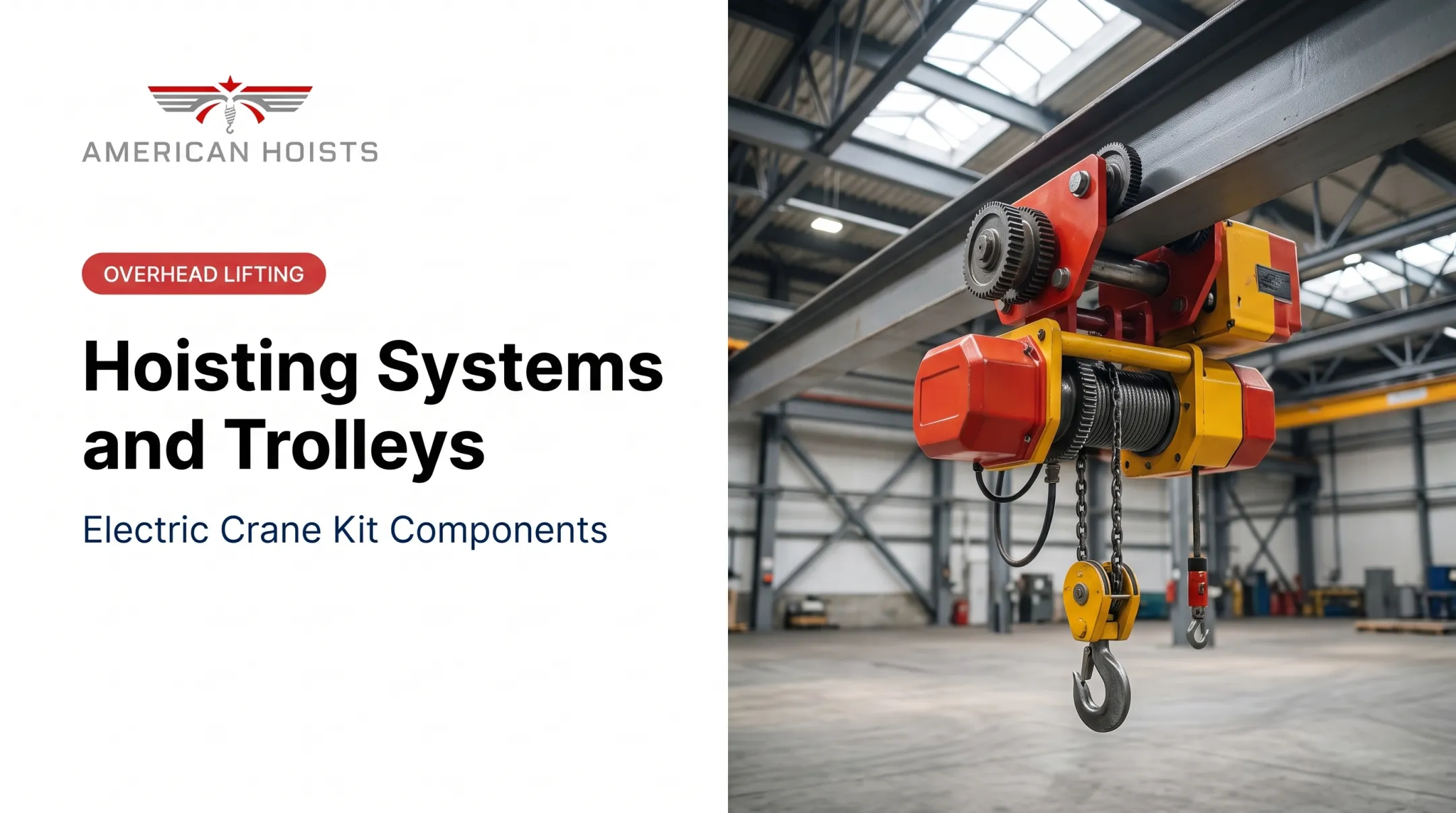
- Wire rope hoists use multiple strands of galvanized steel wire wound around a grooved drum
- Chain hoists use a forged steel load chain that runs through a single sheave
This distinction explains almost every other difference on this list. Capacity, precision, wear patterns, and price all trace back to it.
Durability & Wear Patterns
There's no universal rule that wire rope hoists last exactly twice as long as chain hoists. What's actually documented is how each component wears differently. Hoist Manufacturers Institute guidance notes:
- Chain gets replaced for nicks, gouges, dents, or measured stretching beyond spec
- Wire rope gets replaced for kinking, unstranding, corrosion, broken wires, or birdcaging
Konecranes points out that wire rope's stranded construction, while flexible and strong, can hide internal corrosion and fatigue from a simple visual check. Maintenance teams need to plan inspections around that risk.
Design life, per Konecranes, is consumed in work cycles and running hours, not calendar years. Duty cycle matters more than age when estimating remaining service life.
Lifting Capacity
American Hoists' own lineup illustrates the typical split well. Harrington NER chain hoists span 1/8 ton up to 20 tons, covering everything from light assembly work to heavier factory lifts. Harrington RY and Starke SMW wire rope hoists cover 3 to 15 tons, built for the heavier end of standard industrial lifting.
Zoom out to the broader market, and wire rope hoists scale even further — some manufacturer catalogs list capacities up to 100 tons for built-up rope hoist systems. Chain hoists, by contrast, rarely exceed the 20-30 ton range across the industry.

Lift Precision & Speed
A chain hoist's single-sheave design generally delivers a true vertical lift (defined as the hook block following a straight vertical path with no drift during raising or lowering). That's a real advantage for precision positioning in tight workstations.
Wire rope hoists can achieve true vertical lift too, but it takes specialized reeving or a double-grooved drum to eliminate the natural sway that happens as rope winds across a standard drum.
What wire rope gives up in default precision, it often makes back in speed over long runways, especially in multi-part reeving configurations built for heavier loads.
What Is a Wire Rope Hoist?
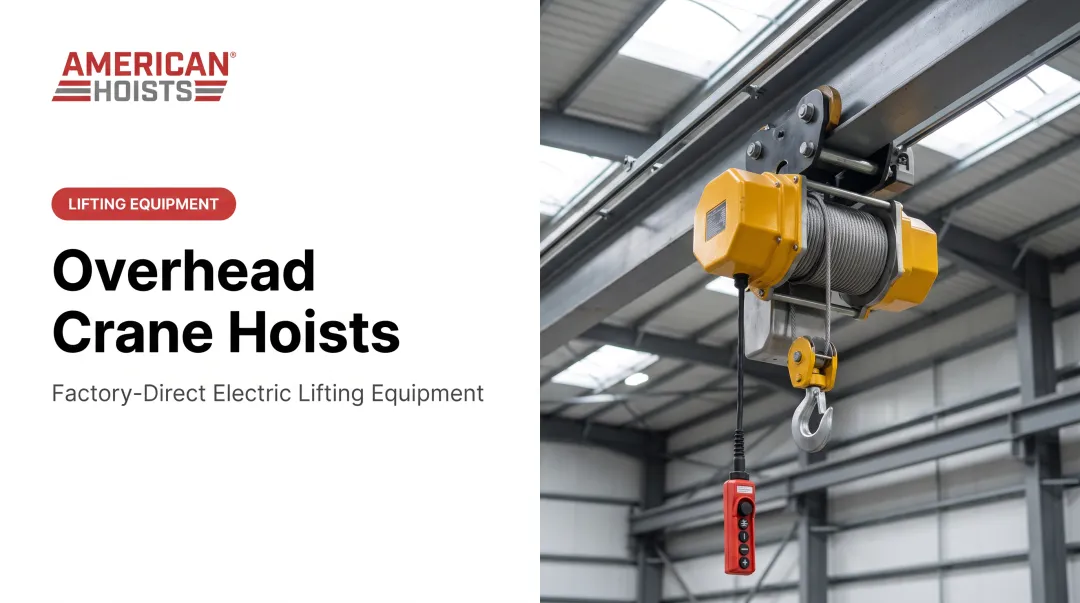
A wire rope hoist moves loads using multiple strands of galvanized steel wire wound around a grooved drum. Manufacturers rely on this design for one reason: it handles heavy, continuous loads without the wear concerns that come with high-cycle chain use.
The operational payoff shows up in three places:
- Higher load capacity for heavy production runs
- Faster lift speeds over long spans, useful on wide bridge cranes
- Reliability under high-cycle use, which cuts unplanned downtime on busy lines
Reeving Systems and Configuration
Reeving is the number of rope "parts" supporting the load, and it changes both capacity and lift speed. Manufacturer configurations typically include 1/1, 2/1, 2/2, and 4/1 arrangements.
- Single-part reeving moves faster but caps out at lower capacities
- Multi-part reeving (2/1, 4/1, and beyond) supports heavier loads and can improve precision with true vertical lift
The tradeoff between speed and capacity depends on the specific hoist's motor and drum design. There's no one-size formula, which is why a specialist consultation matters when you're speccing a system for a particular load.

Where Wire Rope Hoists Get Used
Wire rope hoists dominate in environments where loads are heavy and lifting never really stops:
- Steel mills and foundries
- Galvanizing lines
- Die-handling operations
- Shipbuilding and cement bucket cranes
One real-world example: a Lafayette, Louisiana thermal-processing plant needed to move heat-treatment loads from an oven to a quench tank faster. Switching to a high-speed monorail wire rope hoist increased lift speed from 130 to 157 feet per minute, with heat shields protecting the unit from oven exposure.
That kind of speed gain under continuous, high-heat duty is exactly where wire rope hoists pull ahead.
What Is a Chain Hoist?
A chain hoist moves loads with a forged steel load chain run through a pocket wheel (load wheel), powered manually or electrically. Facilities choose it for compact, flexible lifting on lighter to mid-range loads and for general industrial duty where true vertical lift and easy repositioning matter.
Common advantages include:
- True vertical lift for precise positioning at workstations
- Lower maintenance costs from simpler mechanics
- Easy portability between machines, bays, or job sites
Duty Ratings and Classifications
Duty ratings determine how hard and how often a hoist can safely run. The Hoist Manufacturers Institute defines five classes:
- H1 – standby or infrequent use
- H2 – light service
- H3 – general service, running up to 25% of the work period
- H4 – high volume of heavy loads
- H5 – heavy service approaching continuous operation
American Hoists' Harrington NER electric chain hoists carry an H4 classification with a 60-minute duty rating and Class B insulation, suited to high-volume factory work. The line includes a Guardian Smart Brake with a 10-year hoist-brake warranty and a USA country-of-origin designation across the model range.

Configurations for Portability
Across the market, chain hoists ship as manual hand-chain, electric, or lever styles, with top-hook or lug-mount suspension. Trolley choices (push, geared, or motorized) control how easily a unit moves between workstations.
American Hoists supplies electric Harrington NER chain hoists on a 2 to 4 week ship time across the NER catalog, a schedule that fits planned installations rather than emergency swaps.
Where Chain Hoists Get Used
Chain hoists fit naturally into daily operational tasks:
- Assembly lines and maintenance bays
- Workstation and jib crane setups
- Automotive workshops and small-to-mid manufacturing plants
Overexertion involving objects causes serious workplace injuries costing $12.63 billion annually in workers' compensation, medical, and lost-wage expenses, according to MHI's Overhead Alliance.
Overhead lifting equipment, including chain hoists on jib cranes and workstation setups, replaces much of the manual lifting, pushing, and pulling behind those injuries.
Wire Rope Hoist vs Chain Hoist: Which Is Better for Your Operation?
There's no universal winner here. The right hoist depends on six factors you should weigh together, not in isolation:
- Load capacity – what's the heaviest single lift, realistically?
- Duty cycle – how many lifts per hour, and at what load percentage?
- Headroom – how much vertical clearance does your structure allow?
- Environment – heat, corrosion, moisture, or outdoor exposure?
- Relocation frequency – does the hoist move between stations often?
- Budget – upfront cost versus long-term maintenance spend
Quick Decision Guide
Choose a chain hoist if:
- Your loads stay under 20 tons
- You need frequent repositioning between workstations
- Budget and simpler maintenance matter more than raw speed
Choose a wire rope hoist if:
- You're running heavy, continuous-duty lifts
- Your environment is harsh (heat, corrosion, moisture, or outdoor exposure)
- You need speed over long crane runways
Lead time can factor in, too. American Hoists ships chain hoists in 2 to 4 weeks, while wire rope hoist availability ranges from next-day to 10-12 weeks depending on the model. Check availability before you lock a project timeline.
Real-World Case Study: Matching the Hoist to the Job
NorthTech Manufacturing Group worked with American Hoists' specialist team to find the right lifting equipment for their operation, rather than guessing at capacity or duty rating on their own. David Kim, CEO of NorthTech, described the experience as combining "industrial expertise with e-commerce simplicity": fast, efficient, and customer-focused.

That kind of specialist input matters most when you are choosing between a wire rope and a chain hoist. Nailing capacity, lift height, voltage, and trolley configuration up front avoids the costly trial-and-error that comes with a mismatched unit.
Before you buy, walk the same factors covered above with a specialist:
- Load weight and lift height
- Duty cycle and run time
- Headroom and mounting constraints
- Environment (heat, dust, moisture)
- Budget and lead-time needs
Whether you are upgrading a production line or replacing aging equipment, matching those details to hoist type is what keeps the install from becoming a redo.
Ready to match your load and environment to the right hoist? Request a custom hoist quote or speak with an American Hoists specialist to spec it right the first time.
Conclusion
Neither hoist type wins across the board. The right choice depends on your specific job. A chain hoist fits facilities that need portability, tight-space precision, and lower upfront cost. A wire rope hoist fits where loads are heavy, cycles run constant, and the environment demands tougher equipment.
Match the hoist to load capacity, duty cycle, headroom, and environment first. Let budget guide the final call. Get that match right and you see fewer unplanned outages, safer daily lifting, and equipment that holds up under real production pressure for years.
Need help weighing the tradeoffs? American Hoists specialists can walk you through chain and wire rope options built for U.S. manufacturing facilities.
Frequently Asked Questions
How much weight can a chain hoist lift?
Chain hoists commonly handle 1/8 ton up to 20 tons, though exact capacity depends on the specific unit and its duty rating. Always confirm the model's rated capacity against your actual load before purchasing.
What is the maximum lifting capacity of a wire rope hoist?
Standard industrial wire rope hoists often reach 50 tons or more, with some built-up systems rated up to 100 tons. Reeving configuration plays a major role in how high that maximum climbs.
Which type of hoist is more cost-effective?
Chain hoists are generally cheaper upfront and easier to install, making them cost-effective for lighter, mid-range applications. Wire rope hoists cost more but are necessary once you're dealing with heavier, continuous-duty lifting.
Are chain hoists more durable than wire rope hoists?
Not necessarily. Wire rope hoists typically hold up longer under heavy, continuous use, while chain hoists are cheaper and easier to maintain for lighter-duty work. Durability depends more on matching duty cycle to the equipment than on hoist type alone.
Can I switch from a chain hoist to a wire rope hoist on the same crane system?
Often, yes, but it requires reassessing headroom, mounting points, and trolley or beam compatibility first. Talk to a hoist specialist before making the switch to avoid costly retrofitting surprises.
Which hoist is best for outdoor or extreme environments?
Wire rope hoists generally handle harsh, high-cycle environments like galvanizing lines and foundries better than chain hoists. Chain hoists remain the better fit for general-purpose indoor settings with moderate cycling.