
But not every facility has the right equipment for the job. Manufacturers still lose hours to downtime, safety incidents, and cranes that were never properly matched to their load or duty cycle in the first place.
This guide breaks down how electric cranes work, the main types you'll encounter on a shop floor, and how to pick the right one for your facility.
Key Takeaways
- Motor-driven hoists give electric cranes precise lift-and-move control manual systems can't match
- Match crane type—bridge, gantry, jib, or electromagnetic—to the job and facility layout
- Size first for load capacity, duty cycle, and layout before you compare models or price
- Spec heavy-duty, American-made equipment for continuous manufacturing and 24/7 duty
What Is an Electric Crane and How Does It Work?
An electric crane is a lifting machine powered by electric motors instead of manual effort, hydraulics, or diesel engines. An operator runs a motorized hoist from a control station, so the motor—not muscle—does the lifting.
Here's the basic sequence:
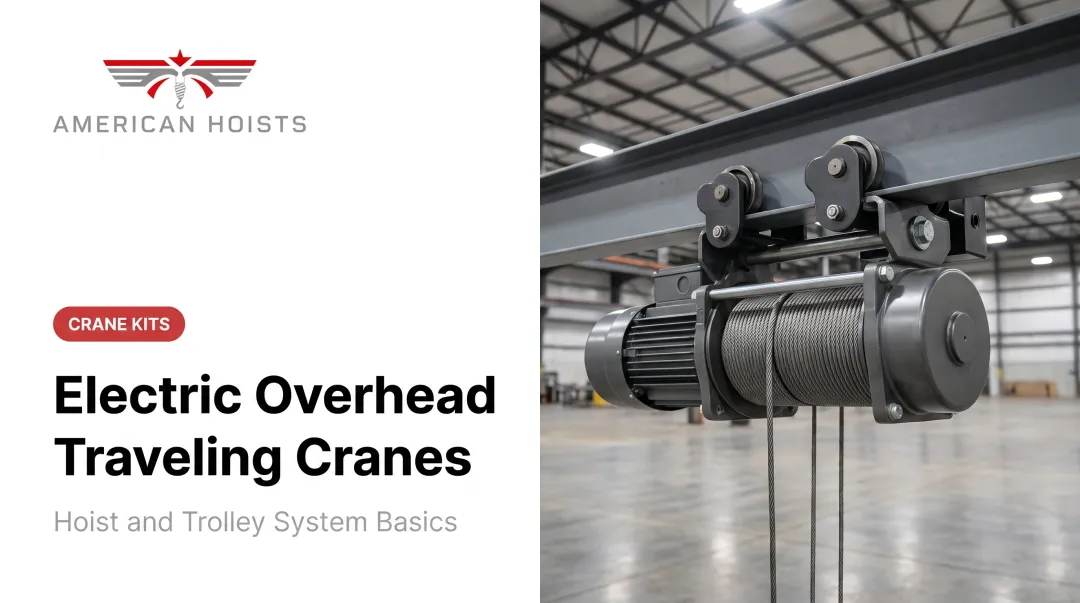
- An electric motor drives a gear system inside the hoist
- That gearing turns a drum, which winds or unwinds a wire rope or chain
- The hoist itself hangs from a trolley, which rolls along a bridge or runway beam
- The trolley moves side to side while the bridge travels the runway length
Together, those motions give full X-Y-Z control. Operators run the system from a pendant or radio remote, adjusting speed and position without touching the load.

Where the Efficiency Gains Come From
Modern electric cranes recapture energy during braking rather than wasting it as heat. Konecranes reports that regenerative braking technology can recapture up to 30% of braking energy on a fully automated crane. That's a meaningful reduction in operating costs over thousands of lift cycles.
A manual hoist still depends on an operator pulling every pound by hand. Electric drive removes that strain, speeds each lift, and keeps positioning consistent shift after shift.
Types of Electric Cranes Used in Industrial Settings
Not all electric cranes look or function the same way. The right type depends on your load size, workspace, and how often you're lifting.
Bridge and Overhead Cranes
Bridge cranes come in two configurations:
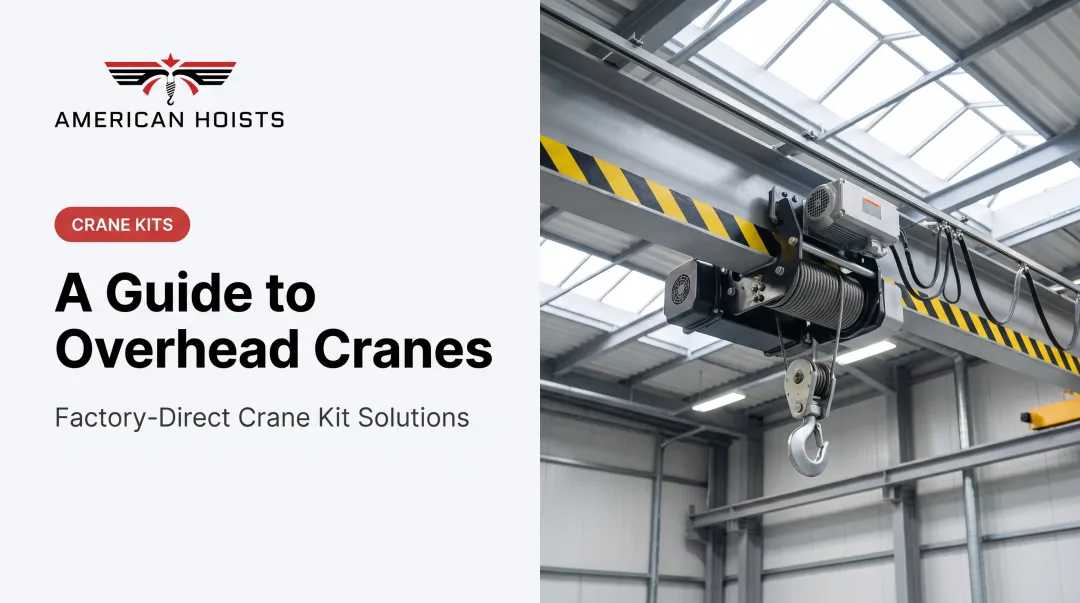
- Single girder: More compact, lighter, and ideal for facilities with limited headroom or floor space. Typically handles up to 40 tons with a normal-headroom trolley.
- Double girder: Built for higher capacity, greater lift height, or when a service platform is needed. Capacities can reach 80 tons or more in standard product lines.
Manufacturing plants and warehouses use these for repetitive, heavy-duty lifting along a fixed runway.
American Hoists' crane kits fall into this category, with top-running kits rated 2–20 tons across 20–84 ft bridge spans, and underhung kits rated 1–10 tons across similar spans. Both come with VFD-controlled, three-motion operation (north/south, east/west, up/down).
Gantry and Jib Cranes
Gantry cranes use floor-mounted legs on wheels or rails, so they don't need overhead structural support. That makes them a fit outdoors, in temporary bays, or where the building can't carry runway loads.
Jib cranes use a pivoting arm on a wall or floor-bolted mast, rotating up to 360 degrees over a workstation. They suit tighter cells where a full bridge crane isn't practical.
American Hoists sells:
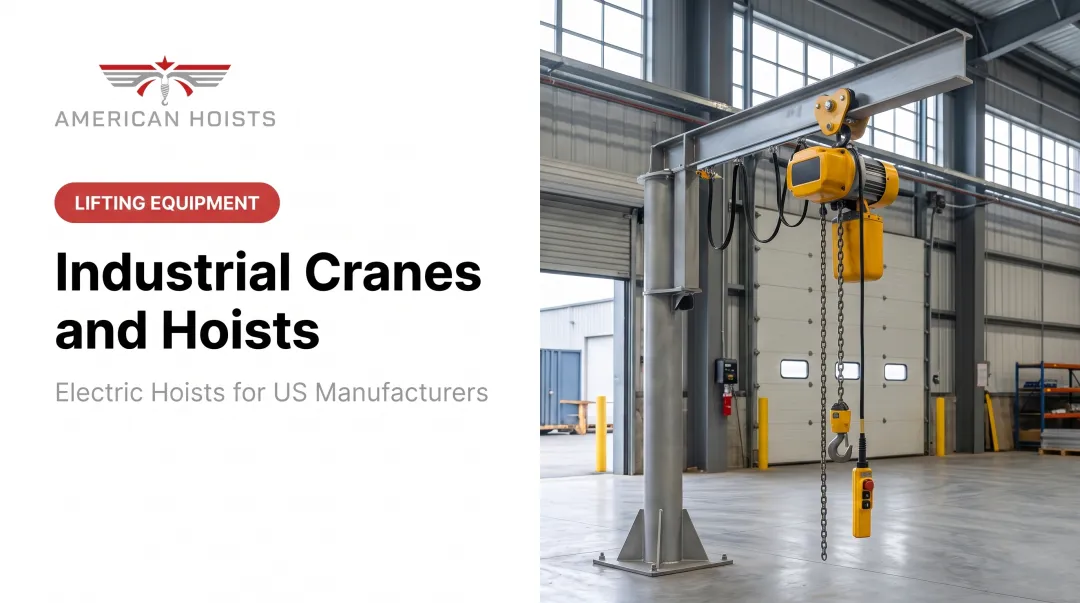
- Wall-mounted jibs: 1/4–5 tons, 180° rotation, jib lengths up to 20 ft
- Freestanding jibs: 1/4–5 tons, 360° rotation, foundationless or base-plate mounted
Wall-mounted units work where you already have suitable columns or walls. Freestanding models cover open floor space without existing structural support.
Electromagnetic Cranes
These swap the hook for an electromagnet, letting them lift ferromagnetic materials like steel plate or scrap directly, with no rigging required.
Steel mills, scrap yards, and metal recycling facilities rely on them heavily. Konecranes notes that scrap-handling cranes in a mill scrapyard can move loads up to 40 tons using magnets, hydraulic grabs, or both.
A power interruption does not automatically mean a dropped load. Battery backup systems built for 230 VDC lifting magnets can hold a load for a set window—documented options range from 5 to 60 minutes—so operators have time to lower or secure the load.

Key Benefits of Switching to Electric Cranes
Electric cranes solve problems manual and diesel systems can't.
Reliability and uptime
- Motor-driven hoists deliver consistent, repeatable performance shift after shift
- Harrington NER/ER models carry an H4 duty classification with a 60-minute duty rating for heavy, frequent industrial use
- American Hoists ships most chain hoists in 2–4 weeks and offers next-day availability on several wire rope models, shortening replacement windows when equipment fails
Cost and energy efficiency
- Regenerative braking cuts wasted energy during operation
- Lower maintenance than diesel equipment: no fuel systems, exhaust components, or engine servicing
Precision and safety
- Integrated overload protection monitors every lift and prevents operators from exceeding rated limits
- VFD (variable frequency drive) controls allow smooth acceleration and deceleration, reducing load sway and impact damage
- Load-cell LED displays on Starke SMW wire rope hoists show exact lift weight in real time
Automation-ready
- Modern electric cranes integrate with plant monitoring systems
- Maintenance teams get visibility into crane health before a failure causes downtime
How to Choose the Right Electric Crane for Your Facility
Getting this wrong means underpowered equipment straining under load—or an oversized system that wastes budget. Load, layout, duty cycle, and supplier support drive the decision.
Load Capacity
Start with the heaviest load you'll realistically lift, then check that figure against both the hoist's rated capacity and the capacity of whatever structure supports it, whether that's a runway beam, monorail, or building column. The equipment rating and the support structure rating both need to clear your heaviest lift.
Span, Height, and Layout
Measure your facility's usable width and ceiling height before choosing a bridge span or lift height. American Hoists' crane kits, for example, come in 20–50 ft and 50–84 ft span options, so matching span to your actual floor plan avoids costly oversizing.
Duty Cycle Classification
Duty cycle tells you how hard and how often the crane will work:
| Classification | Typical Use |
|---|---|
| Light/Moderate (H1-H3) | Occasional lifts, light industrial use |
| Heavy (H4) | High-volume lifting in fabrication shops, mills, foundries |
| Continuous (H5) | Near-constant service, bucket/magnet handling |

Most American Hoists chain hoists and wire rope hoists carry an H4 rating, built for the heavy, repetitive lifting typical of manufacturing floors rather than occasional-use scenarios.
Sourcing Matters
Once you know your specs, the supplier you choose affects how fast you're back up and running. Look for:
- A custom quote process that lets you submit application details when standard catalog options don't fit
- Specialist support available for technical questions, not just order processing
- Realistic lead times—a 10–12 week wait on critical equipment can stall a full production line
American Hoists’ custom hoist quote flow takes your specs and application details up front, with phone support for sizing and configuration so you can lock the right crane without guesswork.
Maintenance and Safety Best Practices for Electric Cranes
Electric cranes need consistent upkeep to stay safe and productive.
Inspection frequency, per OSHA 1910.179:
- Frequent inspections: daily to monthly, covering brakes, hooks, and control functions
- Periodic inspections: every 1 to 12 months, covering structural components and electrical systems
- Idle 1–6 months: inspect before returning to service
- Idle over 6 months: complete inspection required before use
Operator requirements:
- Only designated, qualified personnel should operate the crane
- Load limits must be respected. Overload protection features help, but they don't replace trained judgment
Preventive maintenance:
- Schedule inspections around usage severity, not just the calendar
- Catch small issues early—such as a failing electrical-cabinet cooling system—to avoid extended unplanned downtime
Frequently Asked Questions
How does an electric crane work?
An electric motor drives a hoist's gear system, which winds a wire rope or chain to raise and lower loads. The hoist rides on a trolley along a bridge, giving full control over positioning through a pendant or remote.
What are electromagnetic cranes used for?
They're used in steel mills, scrap yards, and recycling facilities to lift ferromagnetic materials without hooks or slings. Battery backup systems keep the magnet holding the load during power outages.
What is the difference between an electric hoist and an electric crane?
The hoist is the lifting component: the motor, drum, and rope or chain that raises the load. The crane is the full structural system, including the bridge, trolley, and runway, that supports and moves the hoist.
How much weight can an electric crane lift?
Capacity ranges widely, from under a ton for small jib cranes to hundreds of tons for heavy industrial systems. Chain hoists alone span roughly 1/8 ton to 20 tons in common product lines.
Are electric cranes safer than diesel or manual cranes?
Electric cranes offer more precise load control, built-in overload protection, and no exhaust emissions. They also reduce the physical strain that comes with manual chain-pull systems.
How often should an electric crane be inspected?
OSHA guidelines call for frequent inspections (daily to monthly) covering brakes and controls, plus periodic inspections (1-12 months) covering structural and electrical components.