
Choosing the wrong type, though, creates real problems. An undersized wall-mounted unit forces operators to reposition loads manually. An oversized freestanding crane with a full foundation eats into budget you didn't need to spend. Picking the right configuration affects efficiency, safety, and your bottom line.
This guide breaks down the five main types of jib cranes, how they differ, and how to select the right one for your facility.
TL;DR
- Jib cranes use a horizontal boom on a mast, wall, or ceiling for precise lifting in tight spaces
- Main types: freestanding, wall-mounted, mast type, articulating, and portable
- Types differ by mount, rotation range, capacity, and best-fit application
- Choose based on load needs, floor space, mobility requirements, and budget
- American Hoists supplies durable jib cranes and hoists built for continuous use in American manufacturing
What Is a Jib Crane?
A jib crane is an overhead lifting device with a horizontal boom, or arm, extending from a mast, wall, or ceiling to support a hoist. The boom rotates around a fixed pivot point, covering a circular or semi-circular work area.
Jib cranes are built for repetitive, precise lifting in confined workspaces such as workstations, machine shops, and loading docks. Rather than covering an entire building bay like a bridge crane, they put lifting capacity exactly where operators need it.
Why manufacturers choose jib cranes over bridge crane systems:
- Lower installation cost with no runway beams required
- Faster setup, often within days rather than weeks
- Better fit for single-point, high-frequency lifting tasks
- Easier to relocate or reconfigure as production layouts change
Why Are Jib Cranes Important for Industrial Manufacturers?
Manual material handling remains one of the most persistent sources of workplace injury in American industry. NIOSH's Ergonomic Guidelines for Manual Material Handling notes that manual handling work contributes to a large share of the more than 500,000 musculoskeletal-disorder cases reported annually in U.S. workplaces.
That risk shows up on plant floors every day as strained backs, shoulder injuries, and repetitive-motion damage.
Without proper lifting equipment, facilities typically see:
- Higher rates of workplace injury and related workers' comp claims
- Production bottlenecks when heavy or awkward loads slow down a line
- Inconsistent load handling that leads to product damage or rework
- Operator fatigue that compounds over long shifts
A properly specified jib crane addresses each of these problems. It removes manual lifting at repetitive stations, speeds material transfer, and gives operators consistent, repeatable handling. That combination is why jib cranes appear so often at welding stations, assembly cells, and loading docks across U.S. manufacturing plants.

Types of Jib Cranes
Jib cranes aren't one-size-fits-all. Mounting style, rotation range, and load capacity vary significantly based on your facility layout and lifting demands. The right type addresses your specific combination of space constraints, capacity needs, mobility requirements, and budget.
Here's a breakdown of the five main configurations.
Freestanding Jib Cranes
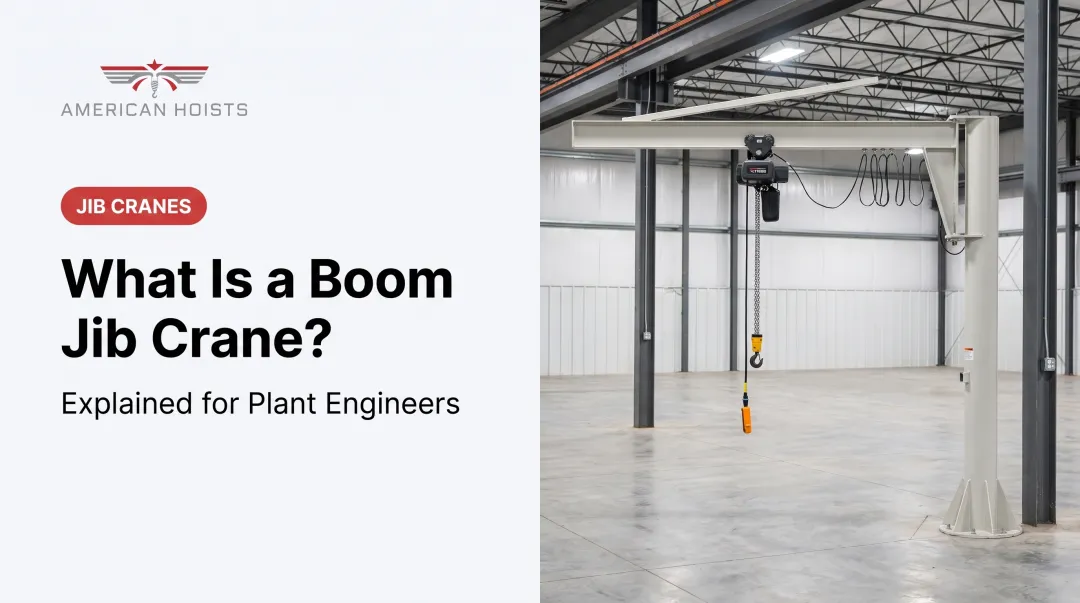
Freestanding jib cranes anchor to their own foundation, whether that's a base plate, poured foundation, or sleeve insert, giving them independent support with no reliance on nearby walls or columns.
How it works: The mast supports the boom and typically allows up to 360-degree rotation, along with the highest load capacities in the jib crane category.
How it differs: Unlike wall-mounted or mast types, a freestanding crane needs no wall or column support at all. That independence is what gives it the largest span and rotation range of any jib crane type.
Spanco's published specifications list freestanding models reaching up to 15 tons with spans up to 50 feet and full 360-degree rotation.
Best suited for:
- Heavy-duty lifting tasks
- Open work cells without adjacent structure
- Indoor or outdoor applications
- Facilities lacking suitable wall support
Key strengths: Highest capacity, full rotation, longest available spans.
Limitations: Requires a dedicated foundation, carries the highest upfront cost, and is the most permanent installation of the five types.
For shops that want freestanding rotation without a full poured foundation, American Hoists offers a foundationless freestanding option rated from 1/4 ton to 1 ton with up to 16 feet of span.

Wall-Mounted Jib Cranes
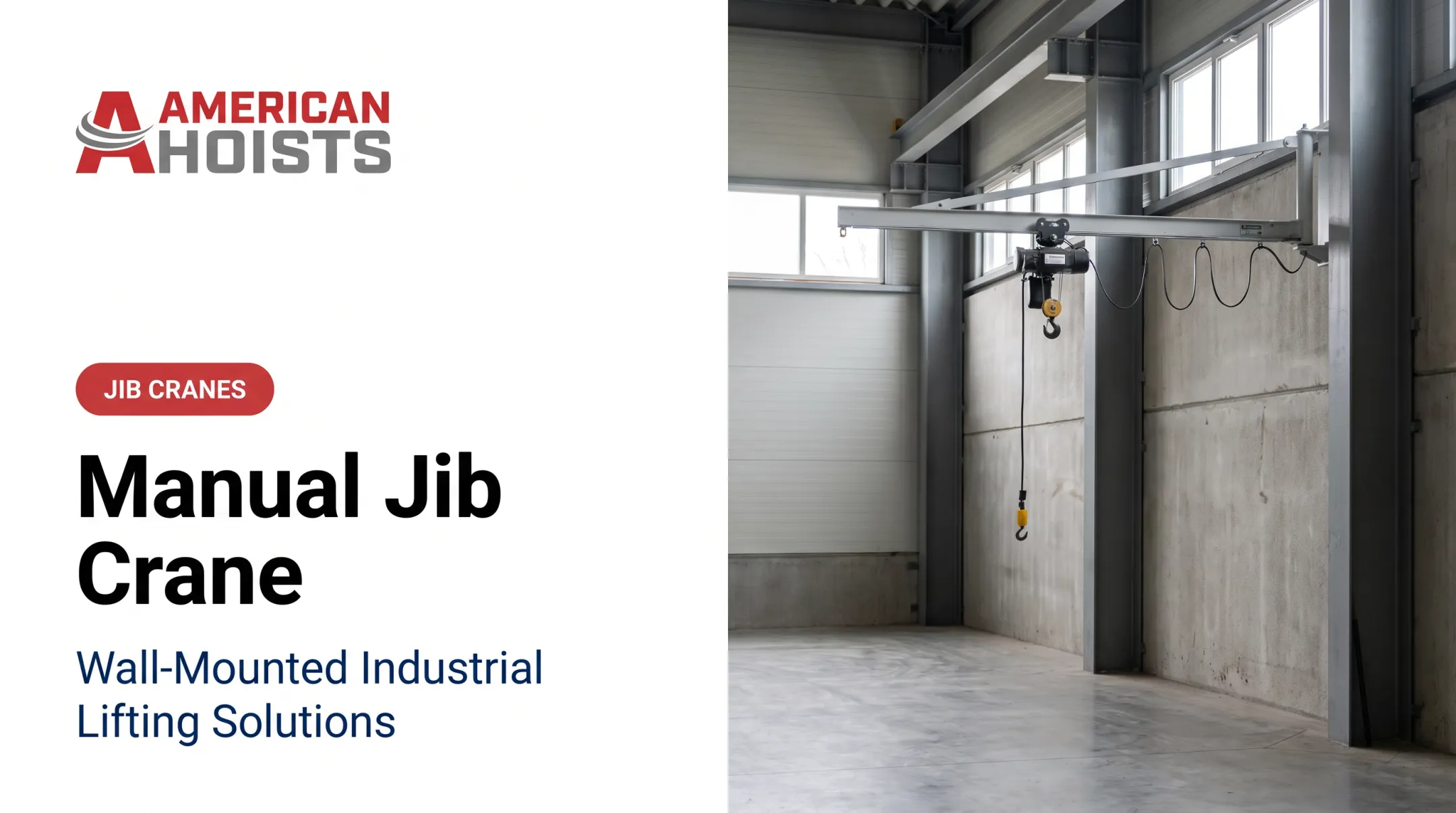
Wall-mounted jib cranes attach directly to a structurally rated wall or column, using either a cantilever or tie-rod bracket. This eliminates the need for any floor space at all.
How it works: The boom swings from a wall bracket, generally rotating between 180 and 200 degrees. American Hoists' Abell-Howe wall-mounted models specifically support 180-degree rotation across a 1/4-ton to 5-ton capacity range.
How it differs: Floor space is a non-issue here, unlike mast or freestanding designs. The tradeoff is rotation. You lose full 360-degree coverage in exchange for a smaller footprint.
Best suited for:
- Facilities with tight floor space
- Maintenance bays
- Fabrication shops needing a fixed lift point
Key strengths: Cost-effective, space-saving, and positionable high on a wall for maximum overhead clearance.
American Hoists lists wall-mounted units starting around $2,500, with the full jib-crane collection ranging up to roughly $6,995 depending on configuration.
Limitations: No full rotation, and the mounting wall or column requires structural engineering review before installation.
Mast Type Jib Cranes
Mast-type jib cranes are floor-supported but stabilized by tying into an overhead beam or truss rather than requiring a full standalone foundation.
How it works: These cranes use a full cantilever or drop cantilever boom design. They need only minimal concrete support at the base since the overhead connection handles much of the stabilizing load.
How it differs: This design costs less than a freestanding crane because it borrows stability from existing overhead structure instead of a dedicated foundation. Gorbel's mast-type jib cranes are floor-supported and top-stabilized, with 360-degree rotation and capacities up to 10,000 pounds.
Best suited for:
- High-capacity lifting without a dedicated foundation
- Buildings that already have strong overhead structure
- Shops that want full rotation at a lower install cost than freestanding
Key strengths:
- Cost-effective alternative to freestanding models
- Capacities reaching up to 10 tons in some manufacturer lines
- Full 360-degree rotation
Limitations: Requires adequate overhead structural support strong enough to anchor the mast connection, which not every building has.

Articulating Jib Cranes
Articulating jib cranes feature a dual-arm design connected by a rotating knuckle, letting the boom bend around obstacles instead of sweeping in a fixed arc.
How it works: The primary arm swivels, and the outer arm rotates independently, so the boom can move into machinery bays or around columns.
Rotation specs vary by manufacturer and mounting style. Spanco's 402 Series supports 360-degree rotation at both arms, while Gorbel's Wall Mounted Pivot Pro lists 200 degrees on the primary arm and 300 on the secondary. There's no single universal spec—check the model sheet.
How it differs: Straight-boom jib cranes can't reach around corners or obstructions. Articulating models can, which makes them valuable in cluttered work cells.
Best suited for:
- Assembly lines with physical obstructions
- Workstations requiring precision placement
- Areas where a straight boom simply can't reach
Key strengths: Excellent maneuverability into confined or obstructed areas that traditional jibs can't access.
Limitations: Lower load capacity, often topping out around 1 ton, and shorter overall span than freestanding or mast types.
Portable Jib Cranes
Portable jib cranes mount on a wheeled or forklift-transportable counterweighted base, requiring no permanent installation at all.
How it works: A counterweight base stabilizes the boom without anchoring to floor or wall. Spanco's portable models list capacities up to 1,000 pounds with 360-degree rotation, while other manufacturers like Air Technical Industries publish ranges up to 2,000 pounds.
How it differs: No foundation costs whatsoever, and the entire unit can be repositioned across a facility as production needs shift.
Best suited for:
- Leased buildings where permanent installation isn't practical
- Facilities with frequently changing layouts
- Temporary job sites
Key strengths: Plug-and-play setup, easy relocation by forklift, zero structural modification required.
Limitations: Lower capacity than most other types, and depending on the base design, portable units can sometimes cost more upfront than a comparable wall-mounted crane.
How to Choose the Right Type of Jib Crane
The right jib crane depends on your facility layout, load requirements, and budget, not on which design is most popular. Freestanding cranes may be common, but that doesn't mean they're right for every application.
Work through these factors before deciding:
- Required load capacity and lifting height: Match the crane's rated capacity to your heaviest regular lift, with margin to spare.
- Available floor space vs. wall/ceiling mounting options: Tight floors push toward wall-mounted or mast designs.
- Rotation range needed for your workflow: Full 360-degree coverage matters for open work cells; 180 degrees may be plenty for a fixed transfer point.
- Frequency of use and duty cycle demands: High-frequency lifting needs equipment rated for continuous operation.
- Indoor vs. outdoor environmental exposure: Outdoor installations need corrosion-resistant components.
- Budget for installation, including foundation costs: A freestanding crane's foundation work can rival the cost of the crane itself.

Pairing the right jib crane with a durable, continuous-duty hoist matters just as much as picking the boom type. American Hoists supplies hoists engineered for 24/7 operation, cutting downtime risk on high-frequency stations where equipment can't afford to fail mid-shift.
What to Check Before Finalizing a Jib Crane Purchase
A few overlooked details can inflate your project cost or leave you with equipment that underperforms.
- Don't overpay for full rotation you won't use. A wall-mounted or mast-type crane often costs less than a freestanding system. If your workflow only needs a 180-degree sweep, skip the full 360.
- Check load capacity limits carefully. Articulating and portable models max out at lower capacities (often 1-2 tons), so verify they can handle your heaviest, most frequent lifts before committing.
- Budget for installation, not just the crane . Foundation work for a freestanding unit can raise total project cost significantly. Foundationless freestanding models reduce that expense when your floor and layout allow.
- Confirm power supply compatibility. Electric jib cranes and hoist systems typically run on 230V or 460V three-phase power. Match your facility's electrical infrastructure before ordering.
Conclusion
Jib cranes reduce manual strain and speed up material handling across American manufacturing facilities. But not all jib cranes solve the same problem.
Freestanding, wall-mounted, mast type, articulating, and portable designs each address a different combination of space, capacity, and budget constraints. Match the type to your layout and load, then pair it with reliable, American-made hoisting equipment, and you get safer floors and fewer production delays.
Frequently Asked Questions
What are the different types of jib cranes?
The main types are freestanding, wall-mounted, mast-type, articulating, and portable jib cranes. Each suits different combinations of space availability, load capacity, and mobility needs.
What is the difference between a jib and a crane?
"Crane" is the broad category of lifting equipment that raises, lowers, and moves loads horizontally. A jib crane is a specific type that uses a rotating boom from a single support point, rather than parallel rails like a bridge crane.
How much does a 2-ton jib crane cost?
Pricing varies by mounting type, span, and rotation range. American Hoists' catalog shows jib cranes ranging from roughly $2,500 to $6,995 depending on configuration. Request a custom quote for exact pricing.
What is the most common type of jib crane?
Freestanding jib cranes are the most common type, thanks to their indoor/outdoor versatility and high load capacity.
Can a jib crane rotate 360 degrees?
Freestanding and mast-type jib cranes typically offer full 360-degree rotation. Wall-mounted units are more limited, rotating about 180 to 200 degrees due to their bracket mounting.
Are jib cranes suitable for outdoor use?
Yes, but outdoor installations need galvanized or corrosion-resistant components to withstand weather exposure. Confirm coating and material specifications with your supplier before ordering an outdoor-rated unit.