
Many facility managers use "hoisting" and "lifting" interchangeably, but they're not the same thing. Hoisting refers specifically to vertical movement, powered by a rope-and-pulley or chain-and-sprocket mechanism. This guide breaks down what a hoisting system actually is, its core components, the main types used in industry, and how to pick the right one for your operation.
Key Takeaways
- A hoisting system raises and lowers loads vertically using a pulley, drum, or sprocket mechanism
- Hoisting is strictly vertical motion; lifting can include horizontal movement via forklifts or boom lifts
- Core components include the hoist unit, chain or wire rope, hook/load block, drum or sprocket, and brake system
- Choose the right hoist based on load capacity, duty cycle, and your facility's environment
What Is a Hoisting System?
A hoisting system is mechanical equipment that raises and lowers heavy loads using a pulley or drum mechanism, powered by electricity, compressed air, or manual force. OSHA defines a hoist by its function: an apparatus that exerts force for lifting or lowering a suspended load (OSHA 1910.179).
The working principle relies on mechanical advantage. A motor drives a drum (wire rope) or a load sprocket (chain), and the rope or chain routes through sheaves to a hook block. More rope parts supporting the load mean less force is needed to move it, though the hook travels slower as a trade-off.

That same principle shows up across industries:
- Construction sites raise building supplies between floors with material hoists
- Drilling operations run drill strings in and out of the wellbore with drawworks and traveling blocks
- Manufacturing plants move raw stock, dies, and finished parts along the production floor
Why Manufacturers Rely on Hoisting Systems
Moving heavy machinery or materials by hand invites injuries and slows production. A properly sized hoist eliminates that manual strain and keeps parts moving safely overhead, clear of foot traffic and equipment.
American Hoists supplies electric chain and wire rope hoists with an H4 duty classification, a Hoist Manufacturers Institute rating for high-volume, heavy-load work rather than occasional lifts.
Hoisting vs. Lifting: Understanding the Difference
Here's the practical distinction: hoisting is vertical-only, moving a load straight up or down along a rope or chain path. Lifting is the broader term, covering equipment like forklifts, scissor lifts, and boom lifts that can move loads horizontally, diagonally, or in multiple directions.
Think of a flagpole. The rope only moves the flag up or down along the pole's fixed line. It can't swing the flag sideways on its own—that's pure hoisting.
Why does this matter on a shop floor? Choosing the wrong category of equipment wastes money and creates safety risks:
- A hoist alone won't reposition a pallet across an aisle
- A forklift can't safely suspend a load 30 feet in the air for extended work
- Combining a hoist with a trolley and bridge crane adds horizontal travel to the vertical lift
Understanding this split helps procurement teams match equipment to the actual task rather than guessing.
Key Components of a Hoisting System
Every hoisting system, whether chain or wire rope, shares a common set of parts. Here's what each one does:
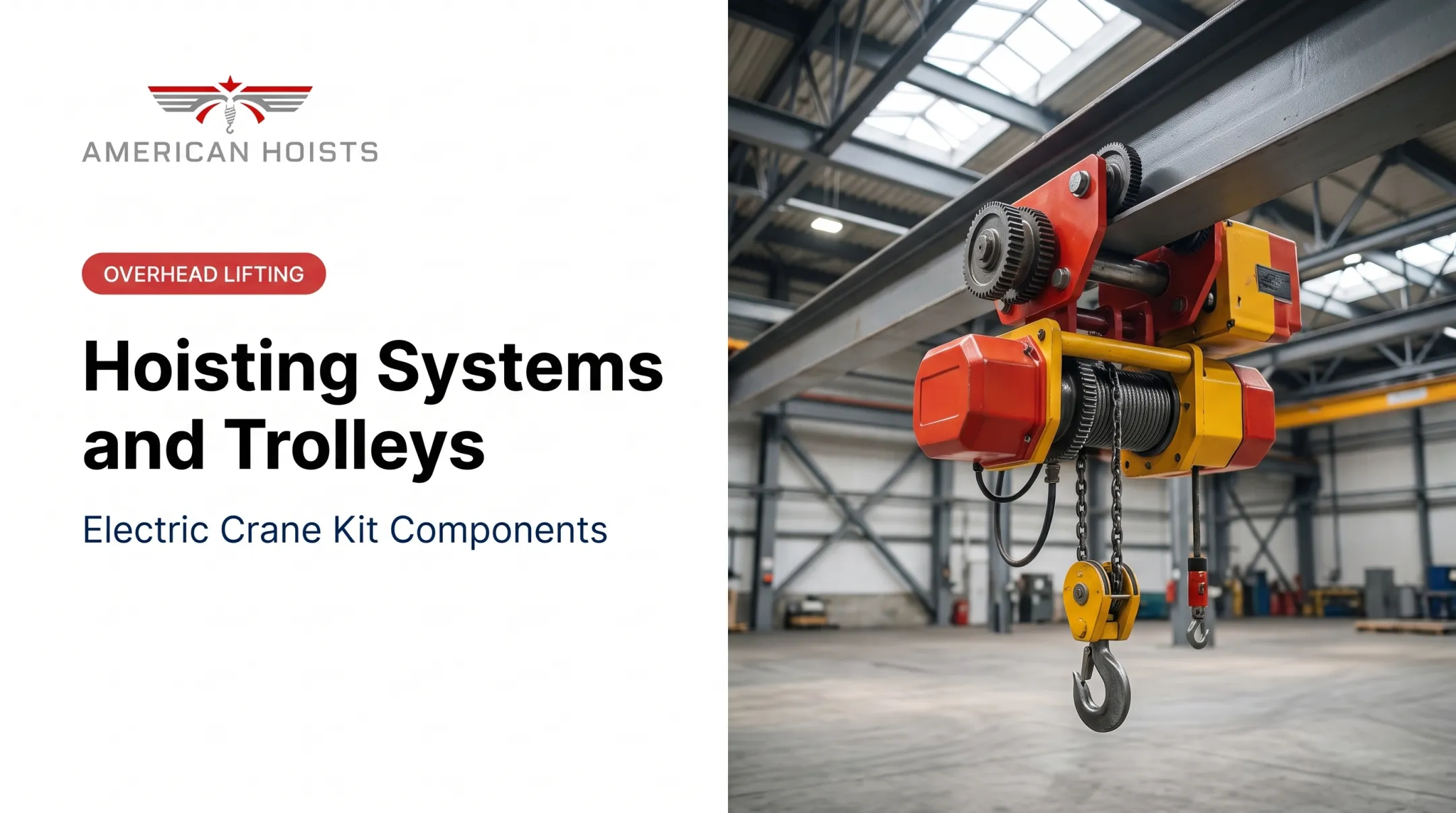
- Hoist unit/motor: The power source (electric, pneumatic, or manual) that drives the lifting mechanism. Harrington electric chain hoists run on a 60-minute duty rating with Class B insulation and cooling fins for repeated heavy use.
- Wire rope or chain: The load-bearing medium—chain on a load sprocket, or coated rope spooled on a grooved drum. Harrington's RY series uses IWRC coated rope with a polymer guide; Starke's SMW uses a deeply grooved drum with a stainless-steel tube guide.
- Drum or reel: Controls how the rope or chain spools in and out during raising and lowering.
- Hook and load block: The connection point to your load. OSHA defines the load block as an assembly of hook, swivel, bearing, sheaves, and frame—not just the hook. Safety latches prevent accidental slip-off.
- Braking and overload protection: Harrington's Guardian Smart Brake uses DC current for fast, fail-safe engagement and carries a 10-year brake warranty. Starke SMW models add a load cell with a 3-inch LED that shows real-time weight and flags overloads early.
- Control system: Pendant controls or remotes let operators manage speed and positioning without standing directly under the load.

Types of Hoisting Mechanisms Used in Industry
Three mechanisms dominate industrial settings, each suited to different conditions.
| Hoist Type | Typical Capacity Range | Best Suited For |
|---|---|---|
| Electric chain | 1/8 ton to 55 tons (portfolio-wide) manufacturer benchmark | Moderate loads, frequent duty cycles |
| Electric wire rope | 2 tons to 80 tons (portfolio-wide) manufacturer benchmark | Heavier loads, continuous operation |
| Pneumatic | Up to 100 tons (mixed pneumatic/hydraulic portfolios) | Explosive or hazardous atmospheres |
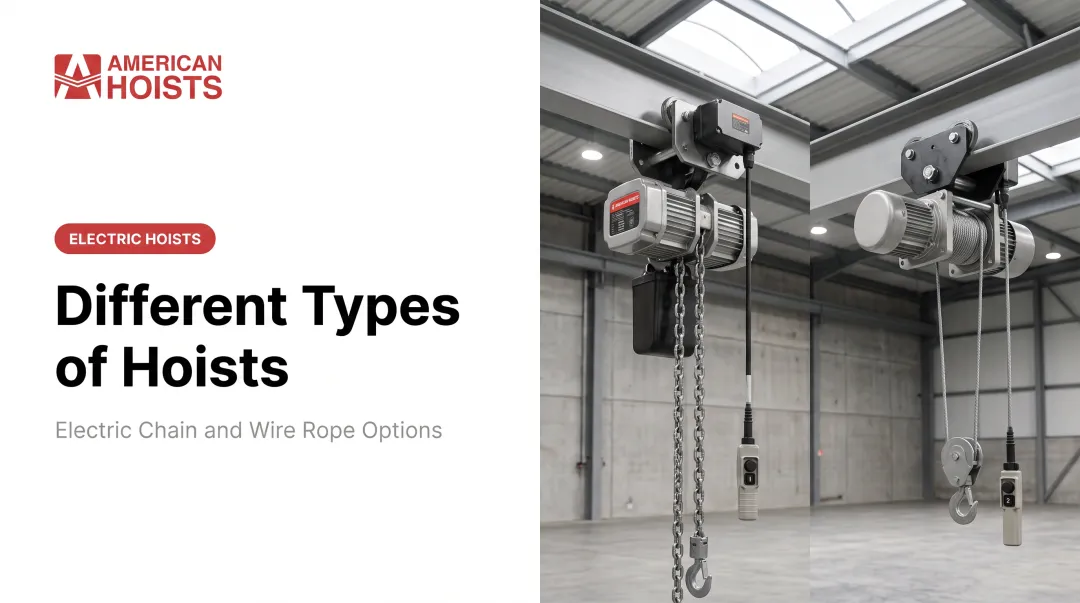
Electric chain hoists are the workhorse of general manufacturing. American Hoists' Harrington NER line spans 1/8 ton to 20 tons, with 19 in-stock models offering lift heights of 10, 15, or 20 feet.
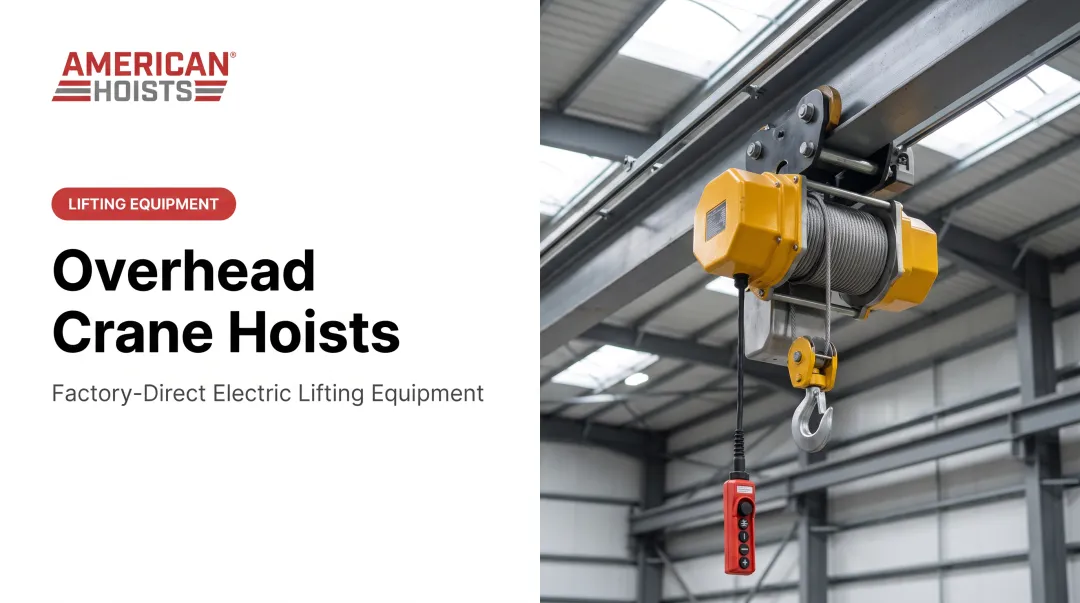
Electric wire rope hoists step up for heavier-duty work. American Hoists carries Harrington RY and Starke SMW models from 3 to 15 tons, with lift heights up to 40 feet and two-speed VFD control on the Starke line.
Pneumatic hoists run on compressed air instead of electricity. That removes spark and ignition risk in paint booths, chemical plants, or oil and gas facilities where classified-location approval is required under OSHA 1910.307.

American Hoists' catalog focuses on electric chain and wire rope hoists rather than pneumatic models.
Common Applications of Hoisting Systems Across Industries
Hoisting systems show up wherever heavy loads need to move overhead without manual handling:
- Manufacturing plants: Moving raw materials, machine parts, and finished goods along the production line
- Warehouses: Loading and unloading trucks, repositioning heavy pallets and inventory
- Construction: Raising building materials and equipment between floors, regulated under OSHA's material and personnel hoist rules
- Fabrication and steel shops: High-volume handling of stock and finished components
The same core mechanics show up in specialized settings too. In drilling operations, a hoisting train—drawworks, traveling block, and hook—raises and lowers the drill string and casing in and out of the wellbore. Different environment, same rope, sheave, and load path.
Choosing the Right Hoisting System for Your Facility
Picking a hoist isn't just about matching a weight limit to your heaviest load. Get these factors right first:
- Load capacity and duty cycle. How much weight, and how often? A hoist running 8 hours a day needs a higher duty classification than one used a few times a week.
- Headroom and space constraints. Measure your available overhead clearance before ordering. Lift height options vary by model.
- Environmental conditions. Dust, moisture, or hazardous atmospheres may require specific electrical protection ratings.
- Lead time versus urgency. If a hoist fails mid-shift, waiting weeks isn't an option.

That last point matters more than people expect. When a hoist fails during a peak production week, days of downtime add up fast—American Hoists can expedite a replacement so production does not stall.
Lead times vary by type: electric chain hoists typically ship in 2–4 weeks, while electric wire rope hoists range from next-day to 10–12 weeks depending on configuration.
For unusual specs—custom lift heights or non-standard voltage—American Hoists' quote team reviews the exact configuration and quotes a match to the job, rather than forcing a standard model into a nonstandard application.
Frequently Asked Questions
What are the different types of lifting mechanisms?
The main categories are forklifts, boom lifts, scissor lifts, and hoists. Hoists use a rope or chain pulley system for vertical movement, while the others rely on hydraulic arms or platforms for multi-directional positioning.
What is the purpose of a hoisting system in drilling?
In drilling, the hoisting system, made up of the drawworks, traveling block, and hook, raises and lowers the drill string and casing in and out of the wellbore during operations.
What is the difference between hoisting and lifting?
Hoisting is vertical-only movement using a rope or chain and pulley mechanism. Lifting is broader, covering multi-directional equipment like forklifts and boom lifts.
What does hoisting mean in construction?
In construction, hoisting refers to raising materials or personnel vertically between floors of a building project, typically using material or personnel hoists regulated under OSHA 1926.552.
What are the different parts of a hoist?
The main parts of a hoist are:
- Motor/hoist unit
- Chain or wire rope
- Hook and load block
- Drum or sprocket
- Brake and overload protection system
How do I know what size hoist my facility needs?
Match the hoist to your maximum load weight, required lift height, and duty cycle. When needs fall outside standard specs, American Hoists specialists can provide a custom quote to size it correctly.