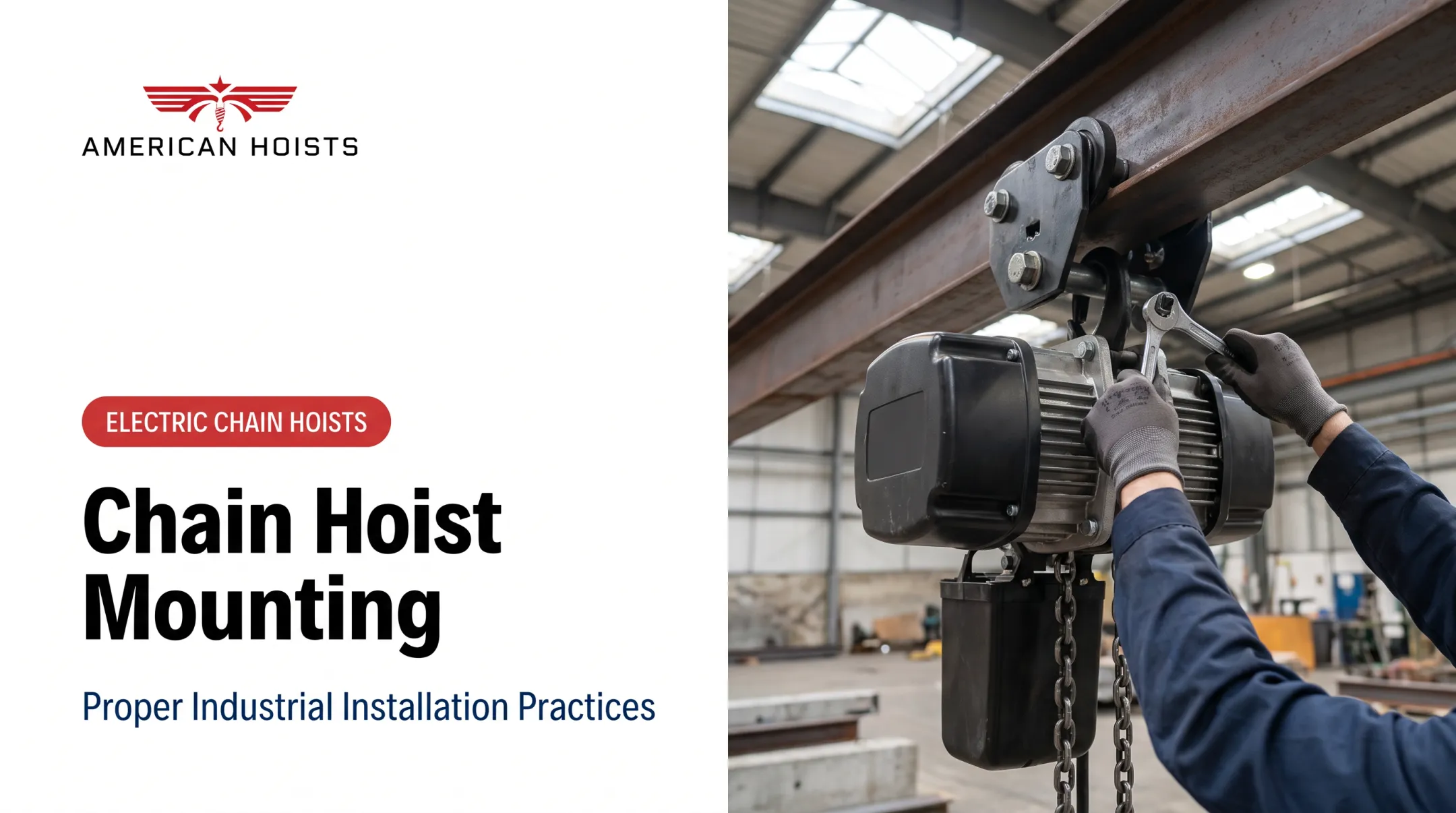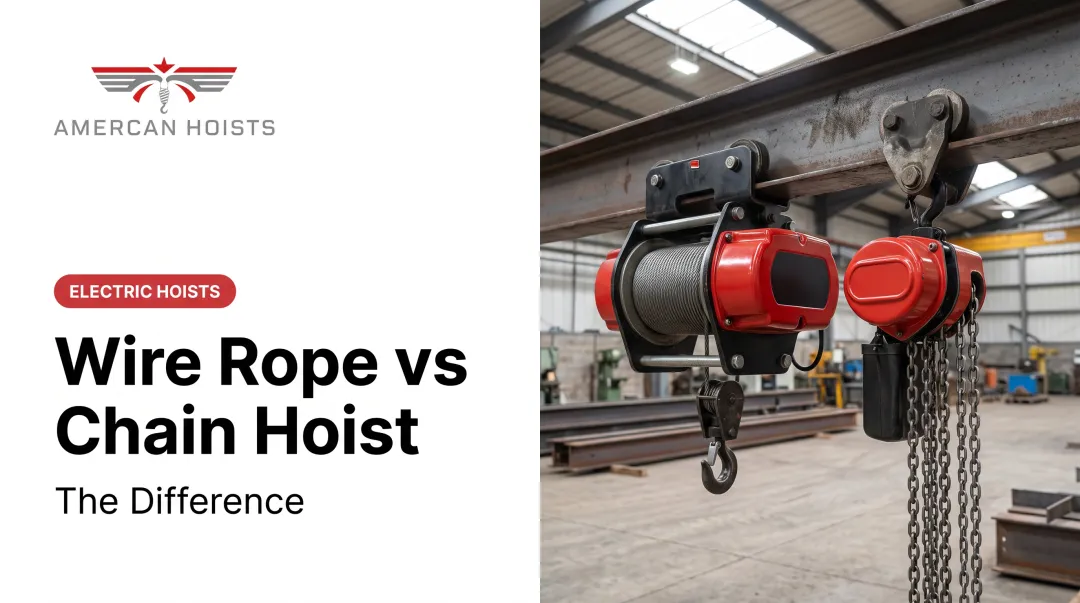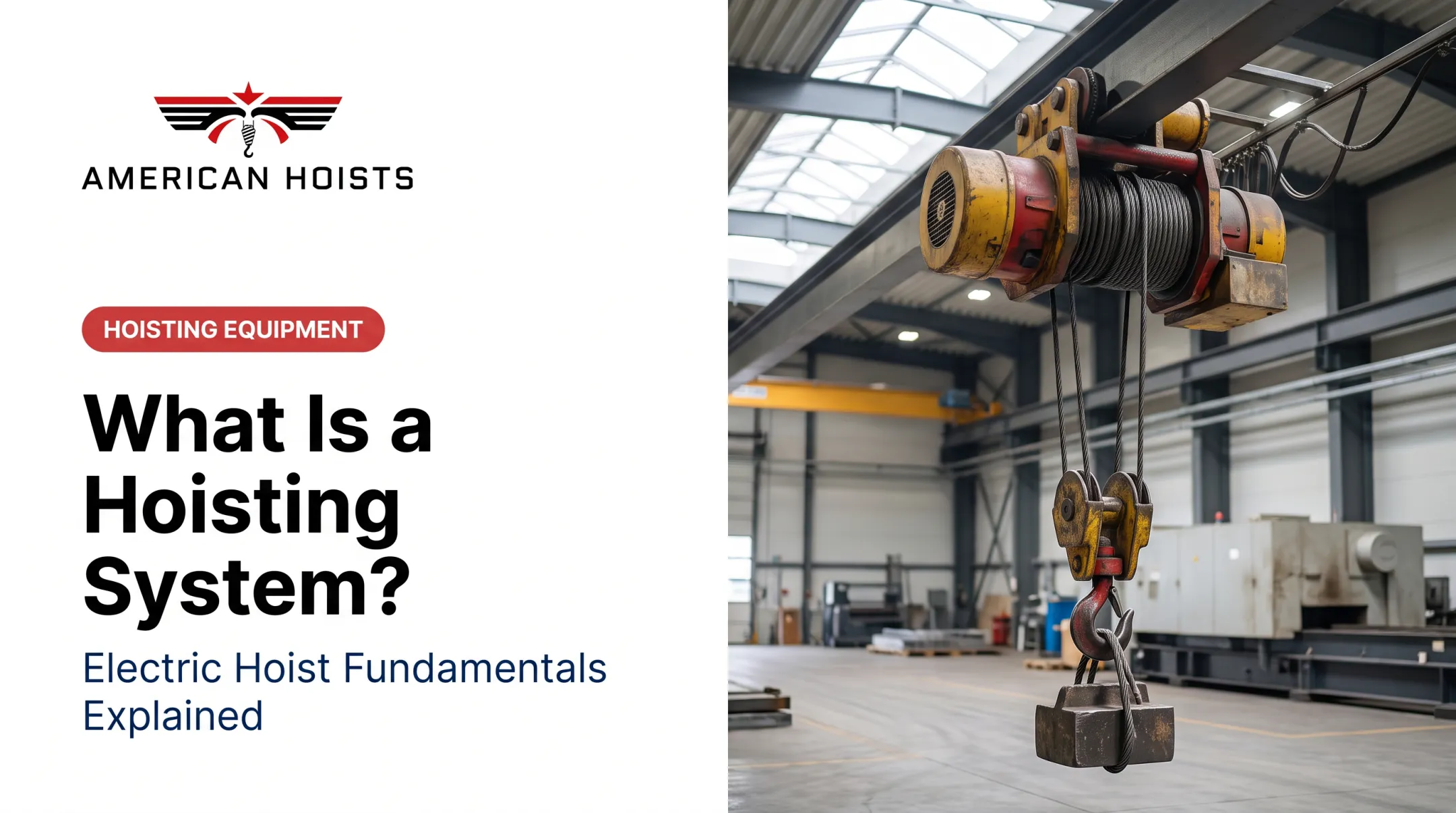

These systems move engine blocks, position HVAC units, and hang stage lighting rigs, often without a second thought from the people using them. That's a problem. When buyers and operators don't understand what's happening inside the housing, they end up with the wrong hoist for the job or miss warning signs before a failure happens.
Downtime from equipment failure isn't cheap. Siemens found that unplanned production outages cost manufacturers $1.5 trillion annually worldwide, with per-hour losses ranging from $39,000 in FMCG plants to over $2 million in automotive settings (Siemens, 2023). This guide breaks down how chain lift mechanisms actually work, what's inside them, and where they fit into real-world operations.
TL;DR
- Chain lift mechanisms use gears and a pocketed load wheel so one operator or motor can lift far beyond human strength
- Hand chain or motor input drives a gear train that turns the load wheel, engaging the load chain link-by-link
- Core components: load chain, pocketed load wheel, gear train, hand chain/motor, brake, hook with latch
- Used across manufacturing, maintenance, theater rigging, shipyards, and construction
- Right hoist selection depends on capacity, speed, duty cycle, and operating environment
What Is a Chain Lift Mechanism?
A chain lift mechanism is a lifting system where a load chain engages a pocketed sprocket wheel, raising or lowering loads through positive, slip-free contact. Unlike a rope wound around a drum, the chain physically locks into the wheel's pockets. There's nothing to slip.
Friction-based systems, like wire rope wound on a drum, work well for high-speed, high-capacity lifting—but they depend on tension and wrap to hold a load. Chain hoists solve a different problem: dependable, positive engagement for shock-prone or intermittent lifting where slip isn't acceptable.
What It Isn't
- Not a wire rope hoist. Wire rope hoists rely on a drum winding cable under friction and tension, better suited to higher speeds and continuous-duty, long-lift applications (Demag, 2023).
- Not a simple pulley block. Pulleys redirect force but offer no gear reduction and no integrated braking.
Chain hoists remain a workshop staple because they store compactly, tolerate shock loading well, and hold up under the stop-start rhythm of intermittent industrial use.
The same gear-and-chain principle shows up in three input forms:
- Manual (hand chain)
- Lever (ratchet-operated)
- Electric (motor-driven)
Only the way force enters the system changes. In industrial plants, electric chain hoists are the standard form of this mechanism for production lifting.
How Does a Chain Lift Mechanism Work?
The mechanism runs through four stages every time it lifts: initiation, core operation, control, and output.
Initiation
Lifting starts when an operator pulls the hand chain, works a ratchet lever, or flips a motor switch. Manual and lever systems depend entirely on operator effort and condition. Electric systems are motor-driven and can run continuously or intermittently without operator fatigue.
Common friction points at this stage:
- Chain twist preventing smooth engagement
- Cold-thickened grease slowing initial movement
- Worn hand-wheel teeth causing hesitation before load wheel engagement
Core Operation
Once initiated, the input rotates a gear train. That gear train reduces speed while multiplying force, before turning the load wheel.
The pocketed load wheel then engages the load chain link-by-link, lifting the load in fixed increments per rotation. This is the mechanical advantage that lets one person move loads no human could lift unassisted.

That advantage comes with a clear trade-off: higher capacity needs more gear reduction, so the hand chain travels farther for each foot of lift. Columbus McKinnon's 622-A manual hoist brochure puts real numbers on it:
| Capacity | Hand-chain travel per 1 ft lift |
|---|---|
| 1/2 ton | 28 ft |
| 1 ton | 42 ft |
| 2 ton | 53 ft |
| 3 ton | 107 ft |
| 5 ton | 163 ft |
Higher reduction lowers the required pull force but slows lift speed (CM Series 622-A brochure). That force-versus-speed balance is built into every manual hoist design.

On the electric side, American Hoists' Harrington NER series shows the same principle from a different angle: lift speeds range from 55 FPM on 1/8-ton models down to 5.5 FPM on 20-ton units. Bigger loads mean slower, more controlled lifting, regardless of whether a human or a motor is turning the gears.
Regulation / Control
Once the operator stops pulling (or the motor stops), something has to hold the load in place. That's the brake's job.
Traditional manual and lever hoists commonly use a Weston-pattern friction brake. A friction disk on the load shaft binds against a ratcheted locking disk under spring pressure. The shaft turns freely while lifting, then resists reverse rotation when stopped (US Patent 3756359A).
Electric hoists often take a different approach. Harrington's NER electric chain hoists, for example, use a Guardian Smart Brake, an electrical fail-safe system that engages using DC current. Fast activation reduces wear on the brake discs and helps preserve correct brake gap, which is why these units carry a 10-year brake warranty.
Either design has the same job: hold a stopped load. Without reliable braking, that load can free-fall. Load limiters and latch hooks back up the brake as secondary safety mechanisms, preventing overload conditions and accidental load release from the hook.

Output / Result
The result is controlled vertical (or angled) movement, delivered through the hook at the end of the load chain. That movement feeds directly into downstream work:
- Positioning equipment on a production line
- Mounting HVAC units or overhead fixtures
- Supporting maintenance lifts on heavy machinery
Repeatable motion matters on the floor. A hoist that skips or jams mid-lift doesn't just slow things down. It introduces risk. Smooth, repeatable output is what separates a hoist you can trust on a 24/7 line from one that becomes a liability.
Key Components of a Chain Lift System
Every chain hoist, manual or electric, relies on the same core parts working together:
- Load chain — Calibrated, heat-treated alloy chain that carries the weight and sets capacity. It must match the load wheel’s pocket geometry; a “similar-looking” substitute is a safety risk.
- Pocketed load wheel and gear train — Converts rotational input into mechanical advantage while keeping chain engagement slip-free.
- Hand chain, hand wheel, or motor — Manual systems depend on operator strength; electric systems, like Harrington’s NER line, use a motor and reduction drive for consistent output regardless of fatigue.
- Brake and hook with latch — The brake holds the load stationary; the latch hook keeps rigging connections secure during movement.

Chain grade matters more than most buyers assume. Columbus McKinnon notes that Grade 80 or Grade 100 alloy chain is required for overhead lifting. Grade 70 (heat-treated carbon, non-alloy) is for tie-down and lashing only, not overhead lifts (CMCO chain grades).
Always confirm the OEM chain specification for your exact hoist model rather than assuming compatibility.
Where Chain Lift Mechanisms Are Used
Chain hoists show up at nearly every stage of a manufacturing or warehouse workflow:
- Material staging — moving raw stock into position before processing
- Assembly line positioning — lifting components into place during builds
- Equipment maintenance — supporting machinery during repair or teardown
- Loading and unloading — handling freight and heavy parts at dock areas
Where They Perform Best
Chain lift systems excel in specific conditions:
- Vertical lifts with limited horizontal travel
- Shock-prone loads where sudden jolts could cause slip in a friction system
- Continuous-duty industrial settings running around the clock
- Environments requiring compact, space-efficient storage
Applications also vary by industry:
- Theatre rigging — hand-chain hoists and electric chain motors for precise, quiet lighting and set movement (CMCO entertainment applications)
- Shipyards — governed by OSHA 29 CFR 1915.114, which requires clear capacity marking and regular inspection of lift chain, pinions, sheaves, and hooks
- Heavy manufacturing — continuous-duty capacity; American Hoists supplies Harrington NER chain hoists with H4, 60-minute duty ratings for plants that run around the clock
Conclusion
A chain lift mechanism's reliability comes down to three things working in sync: gear reduction that multiplies force, positive chain engagement that resists slip, and a brake that holds the load without fail.
How those parts work together shapes purchasing decisions. Match hoist capacity, chain grade, and duty cycle to your real operational demands. That fit is what keeps downtime and safety incidents off the plant floor.
Frequently Asked Questions
How does a chain lift work?
Pulling the hand chain or activating the motor turns a gear train, which reduces speed while multiplying force. That gear train rotates a pocketed load wheel, which engages the load chain link-by-link to raise the hook.
What are the three types of chain hoists?
Manual (hand chain), lever (ratchet-operated), and electric (motor-driven). All three rely on the same core gear-and-chain principle; only the input method changes.
What are the types of lifting mechanisms?
Common types include chain hoists, wire rope hoists, lever hoists, and hydraulic lifts. Each suits different combinations of load capacity, lift speed, and duty cycle.
How do I know if a chain hoist is safe to use?
Inspect the load chain, hook, and brake for wear or damage before each use. Never exceed the manufacturer's rated capacity, and follow the load rating guidelines printed on the unit.
What's the difference between a chain hoist and a wire rope hoist?
Chain hoists offer slip-free engagement and strong shock absorption, ideal for compact, workstation-level lifting. Wire rope hoists suit higher-speed, higher-capacity, and longer-duration continuous lifting.
How often should chain hoists be inspected?
ASME B30.16 guidance points to annual periodic inspections for normal service, with more frequent checks (weekly or even daily) for heavy or severe-duty operations (HMI/Overhead Lifting).