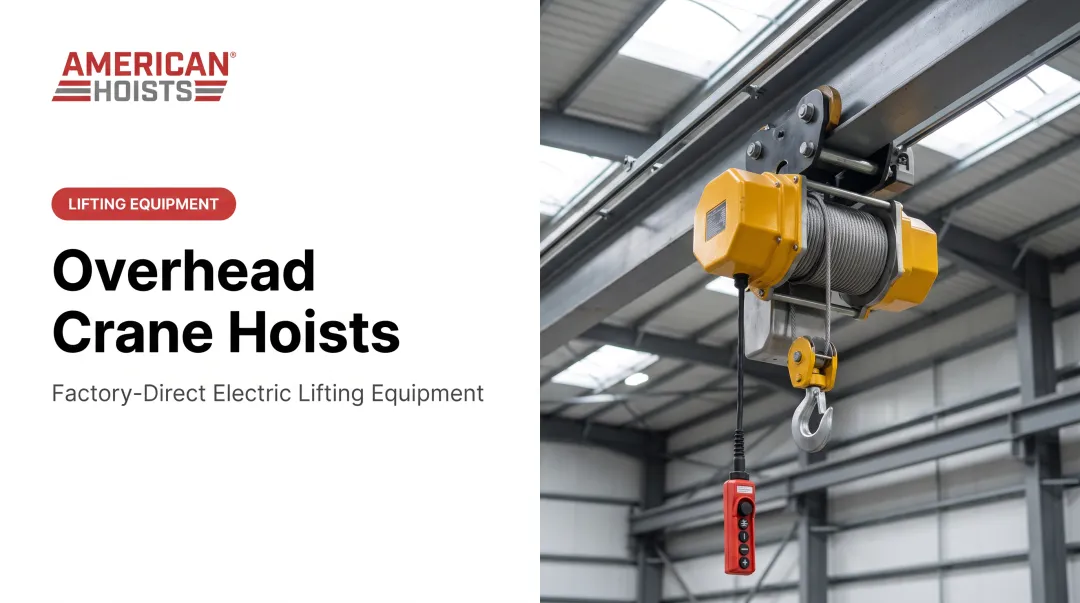

Many manufacturers struggle with this exact problem when planning a new production line or upgrading an aging facility. Misreading specs like capacity, span, or duty cycle doesn't just cause delays. It creates safety hazards and forces expensive retrofits after installation.
This guide breaks down every core hoist and crane specification you need to understand before requesting a quote, from load capacity to duty classification standards.
Key Takeaways
- Capacity, lift height, span, and headroom (C-dimension) form the foundation of any crane specification
- Duty cycle classification (CMAA for cranes, HMI/ASME for hoists) matches equipment life to your real usage intensity
- Wire rope vs. chain: wire rope for heavier, frequent lifts (5+ tons); chain for lighter, occasional work
- Correct specs up front prevent downtime, safety incidents, and expensive rework
What Are the Core Hoist Crane Specifications?
"Specifications" means the measurable parameters defining exactly what a hoist or crane can safely do. Think of them as the vital stats a supplier needs before they can even quote your equipment correctly.
Load Capacity (Rated Load)
Rated load is the maximum weight a hoist is designed and built to lift safely. This figure should always include a margin above your actual expected loads, not match them exactly.
Typical capacity ranges:
- Chain hoists: typically under 10 tons (many lines span 1/8 ton to 20 tons)
- Wire rope hoists: 5 tons and up, often scaling past 30 tons for heavy industrial work
American Hoists' Harrington NER chain hoist line, for example, spans 1/8 ton through 20 tons, all three-phase, giving buyers granular capacity steps rather than forcing a jump between broad tiers.
Span and Lifting Height
Span is the horizontal distance between runway rail centerlines. Lifting height (hook height) is the vertical distance the hook travels from its lowest to highest point.
Here's the catch: your usable lift height isn't just "floor to ceiling." It's reduced by headroom loss from the hoist's own construction, which brings us to the C-dimension.
Headroom and C-Dimension
The C-dimension measures from the hook saddle to the top of the trolley wheels. Demag defines it precisely as the reference point that determines how much of your building's clearance actually converts into usable hook travel.
A larger C-dimension eats into your lift height. That's why low-headroom hoist designs matter so much for facilities with limited building clearance.
Practical implication: two hoists with identical rated loads can deliver very different usable lift heights depending on their C-dimension. Always request this figure on the spec sheet, not just the advertised lift height.

Speed and Reeving Configuration
Lifting and travel speeds (measured in feet per minute) and reeving configuration (1/1, 2/1, 4/1) both shape capacity and headroom.
Higher reeving (such as 4/1) increases lifting capacity, but extra rope parts add bulk and slightly reduce available lift height.
A Harrington NER 1/8-ton model, for instance, moves at 55 FPM, while a 20-ton model on the same line runs at 5.5 FPM. Speed and capacity trade off directly. Don't assume every model in a product family runs at the same pace.
Duty Cycle and Classification Standards
Duty cycle matching prevents you from buying equipment that looks right on paper but fails within months. It's the difference between a hoist rated for occasional lifts and one built for constant, near-capacity cycling.
CMAA Class A-F: Crane System Duty
CMAA classifications describe how hard the overall crane system works:
| Class | Service Level | Example Benchmark |
|---|---|---|
| A | Standby/infrequent | Up to 2 lifts/hour |
| B | Light service | 2-5 lifts/hour, 50% rated load |
| C | Moderate service | 5-10 lifts/hour |
| D | Heavy service | 10-20 lifts/hour, loads near 50% |
| E | Severe service | 20+ lifts/hour, near-rated loads |
| F | Continuous severe | Near-rated loads continuously |

Mazzella's CMAA classification guide breaks these down further, and Class C is frequently the default quote when no duty requirement is specified. That's a reason to document your actual cycle, not a reason to accept the default blindly.
HMI/ASME H1-H5: Hoist Duty
While CMAA covers the crane system, hoist duty uses a separate H1-H5 scale based on starting frequency and load spectrum:
- H1: Idle service, one to six months between uses
- H2: Light maintenance work, infrequent random loads
- H3: General machining, running time under 25% of shift
- H4: High-volume handling near rated capacity, up to 50% running time
- H5: Bulk handling, approaching continuous operation
CMAA/HMI vs. FEM: Know Which Standard Applies
Most US manufacturers work with CMAA and HMI/ASME standards. FEM standards are used internationally and cover hoist, trolley, and bridge motion differently. If a supplier quotes FEM ratings, insist on a written crosswalk to CMAA/HMI equivalents. Don't accept a translated class letter without the load-spectrum calculations behind it.
Skip that crosswalk and mismatched duty class becomes a genuine failure driver. Running a hoist at picks near 50% of rated capacity throughout a shift, when it wasn't rated for that frequency, builds excess heat in motors and controls and leads to premature breakdown.
American Hoists lists Harrington NER chain hoists with a 60-minute duty rating and H4 classification, so you can match the unit to your cycle without guessing.
Choosing Between Wire Rope and Chain Hoists
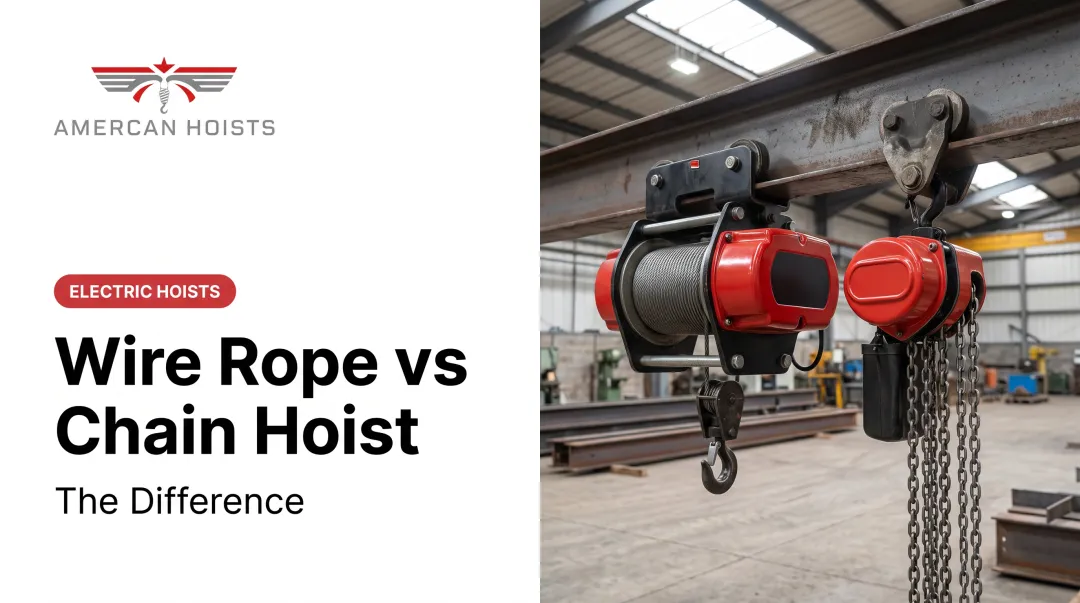
This decision shapes your equipment budget and maintenance plan for years. Use the comparison below to match hoist type to capacity, duty, and upkeep.
| Factor | Chain Hoist | Wire Rope Hoist |
|---|---|---|
| Capacity range | 1/8–10 tons (up to 20 in some lines) | 3–15+ tons |
| Speed | Slower, compact motion | Faster, higher throughput |
| Duty rating fit | H3/H4 light-medium | H4/H5 heavy-continuous |
| Maintenance | Simpler, lower cost | Larger components, more parts |
| Contamination resistance | Link pockets can trap dust; links clean/replace easily | More surface area; needs regular lube and inspection |

When Chain Hoists Make Sense
Chain hoists are compact and economical for lighter, less-frequent lifts—typically under 5–10 tons.
- Best fit: Light to medium duty (H3/H4), tighter spaces, lower maintenance budgets
- American Hoists line: Harrington NER, 1/8–20 ton
- Lift speeds: About 5.5–55 FPM depending on capacity
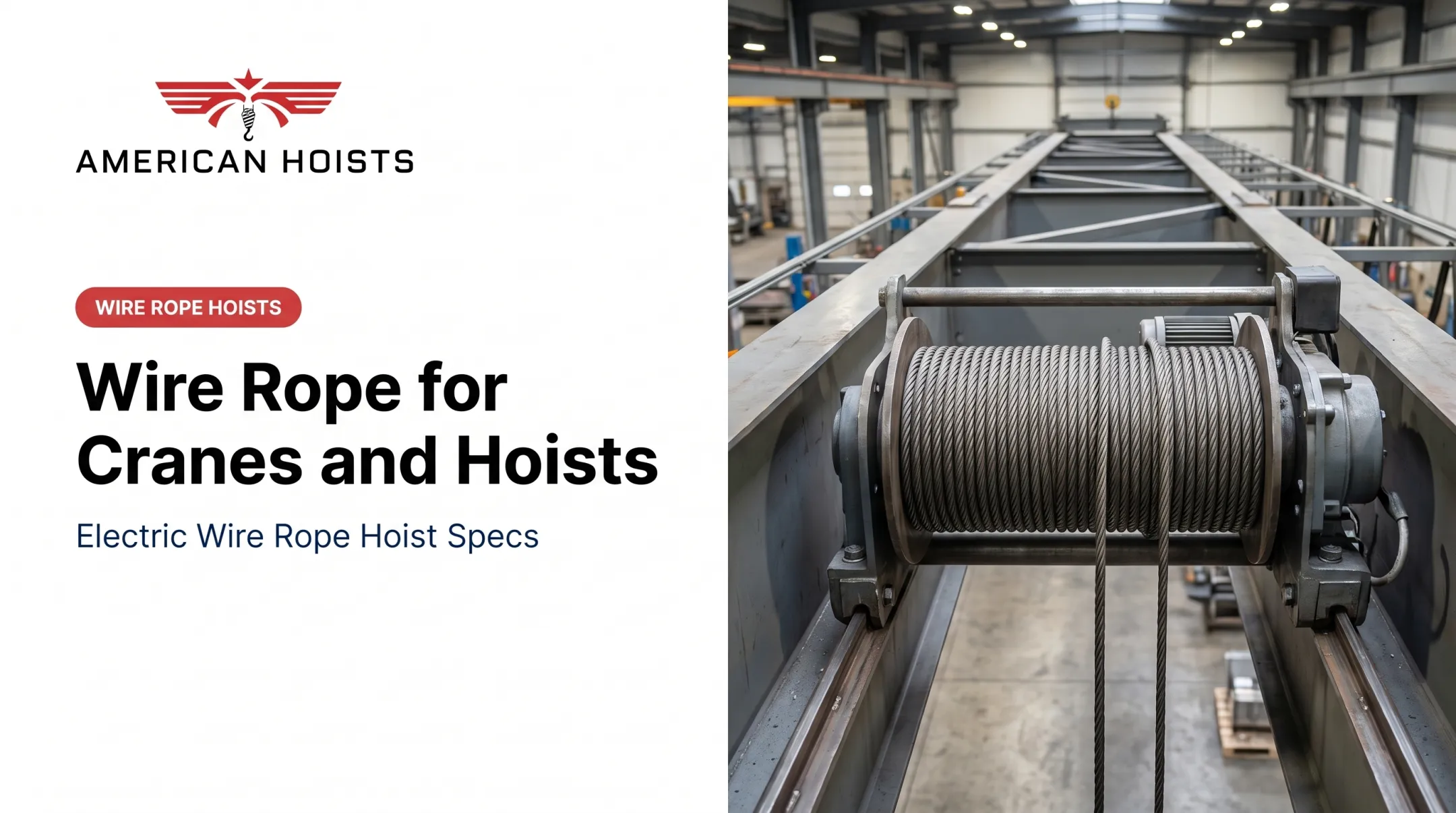
When Wire Rope Hoists Win
Wire rope hoists deliver higher speeds and capacities and hold up in severe-duty (Class D–F) service.
- Best fit: Heavier continuous duty (H4/H5), higher throughput bays
- American Hoists lines: Harrington RY and Starke SMW, 3–15 ton
- Duty callout: Starke SMW models rated ASME H4 for heavy industrial use
Power Source Considerations
Power source belongs on the spec sheet before you buy:
- Manual: Low cost, no power, poor fit for high-frequency work
- Electric: Standard for continuous operation; three-phase is common in plants
- Pneumatic: Preferred in explosive or certain contaminated environments
American Hoists sells electric three-phase only (230V or 460V), aligned with continuous-duty use in U.S. manufacturing facilities. Manual and pneumatic units are outside the catalog.
Bridge and Trolley Specifications to Consider
Beyond the hoist itself, the bridge and trolley setup determines how the whole system performs.
Single Girder vs. Double Girder
- Single girder: Common for 1-15 tons, lower cost, lower weight
- Double girder: Typically used above 15 tons, or when you need to preserve hook height despite deeper girder construction
American Hoists' crane kits follow this split. Underhung kits are rated 1-10 tons; top-running kits cover 2-20 tons. You get a configuration matched to your load range, not a generic frame.

Trolley Gauge and Headroom Types
Trolley gauge is the center-to-center distance between trolley wheels. You'll typically choose between:
- Low headroom: For buildings with limited clearance
- Normal headroom: For standard clearance facilities
- Double girder trolleys: For higher-capacity, wider-span applications
Confirm runway compatibility first. Verify end trucks and runway rail fit before you lock any crane spec. A perfectly rated hoist is useless if it doesn't match your existing runway system.
How to Confirm Specifications Before Ordering
Before requesting a quote, document these parameters:
- Maximum load weight, including your safety margin
- Lift height required, accounting for C-dimension loss
- Span between runway rails
- Duty cycle, both CMAA class and HMI/ASME rating
- Power supply, voltage and phase available at your facility
Working with a specialist to verify these against your actual building constraints—ceiling height, floor layout, and existing runway beams—saves you from an expensive mismatch after delivery.
American Hoists offers a custom hoist quote service backed by 24/7 specialist support. You submit product, options, and specification details, and the team reviews the request so the equipment matches your application—not whatever happens to be in stock.
One maintenance supervisor reported that discussing requirements upfront meant several hoists arrived exactly as specified, with no rework needed.
Frequently Asked Questions
What are the 5 specifications of a crane?
The five core specs are load capacity, span, lifting height, duty classification, and speed. Together, these define what a crane can safely lift and how efficiently it performs.
What is the rated load for a hoist?
Rated load is the maximum weight a hoist is designed to lift safely. It should never be exceeded, even briefly, since doing so risks equipment failure and serious injury.
What is the difference between crane duty classification and hoist duty classification?
CMAA classifications (A-F) rate the crane's bridge and trolley system based on service pattern. HMI/ASME classifications (H1-H5) rate the hoist itself based on starting frequency and load spectrum.
How do I know what lift height I need for my facility?
Measure from your floor to the lowest building obstruction, then subtract the hoist's C-dimension. That remaining distance is your usable lift height.
What's the difference between a wire rope hoist and a chain hoist?
Chain hoists are compact and economical, suited to lighter loads, typically up to 5–10 tons. Wire rope hoists handle higher capacities at faster speeds and hold up better under continuous, heavy-duty cycles.
How often should hoist specifications be reviewed or updated?
Review specs whenever load demands increase, your facility layout changes, or you're planning an equipment upgrade. Annual reviews are a reasonable baseline for active production lines.