
Manufacturers, warehouses, and steel mills increasingly rely on overhead lifting systems to avoid line stoppages. This guide breaks down the main crane types, their core components, and how to match the right setup to your facility.
TL;DR
- Overhead cranes come in five main types: bridge, gantry, monorail, jib, and workstation—each matched to different layouts and loads
- Core components to specify on every system: bridge, hoist, trolley, runway, and end trucks
- Choose by load capacity, span, hook height, and operating environment
- American Hoists supplies bridge cranes, wire rope hoists, and chain hoists for U.S. industrial facilities
What Is an Overhead Crane and Why Does It Matter?
OSHA defines an overhead crane as a crane with a movable bridge that carries a hoisting mechanism, traveling along a fixed overhead runway structure. In plain terms: it's a system that moves loads horizontally through elevated space using a hoist and trolley.
You'll find these systems in:
- Manufacturing plants and fabrication shops
- Warehouses and distribution centers
- Steel mills and heavy industrial facilities
Choosing the wrong crane type creates real problems. A crane that's undersized for the load, or poorly matched to your building structure, leads to bottlenecks, safety risks, and unplanned downtime. A breakdown can delay production, force inefficient workarounds, and drive up labor costs. This guide walks through the main overhead crane types and the components that set capacity, coverage, and reliability so you can specify correctly the first time.
Types of Overhead Cranes
Overhead cranes aren't one-size-fits-all. Load requirements, building layout, and available overhead space all shape which type makes sense. Get the type wrong, and you'll pay for it in efficiency, safety, or cost down the line.
Bridge Cranes (Single Girder & Double Girder)
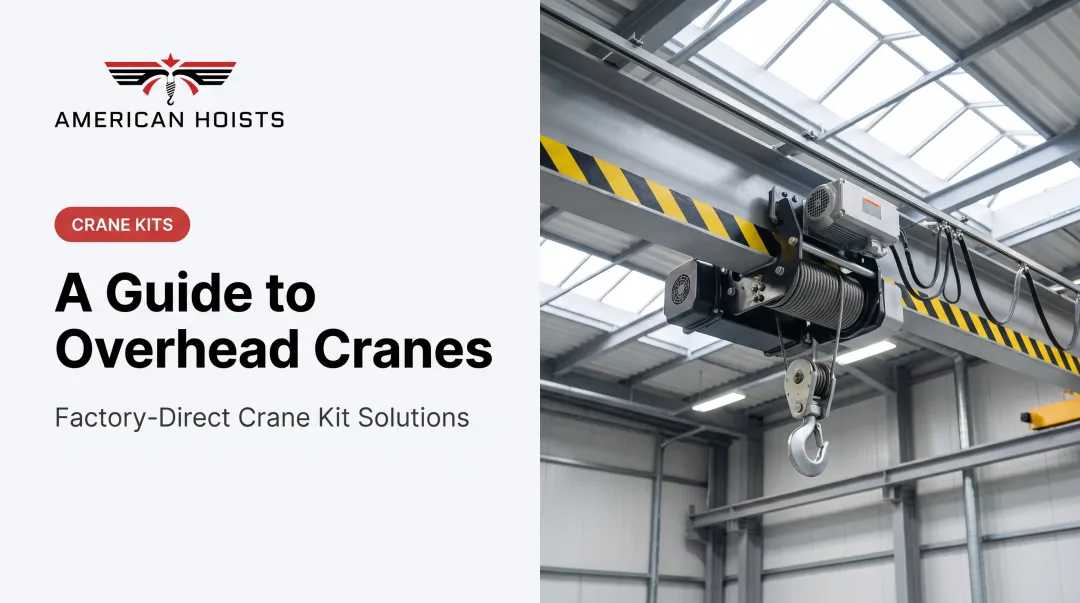
A bridge crane spans two runways with a horizontal bridge carrying a trolley and hoist. The Crane Manufacturers Association of America (CMAA) generally places single-girder cranes below 15 tons, with box-girder designs covering spans up to 80 feet.
Double-girder configurations support higher capacities and longer reaches, with typical spans of 120 feet or more.
- Best for: Manufacturing plants and warehouses needing consistent, repeatable overhead lifting
- Key strength: Wide capacity range and dependable performance
- Limitation: Requires building structure or dedicated runway support; double-girder installation costs more
American Hoists' Harrington HBC Series ships as a fully assembled bridge crane, available with either a chain hoist (1/8 to 10 tons) or wire rope hoist (3 to 10 tons), in 8-10 weeks—compared to industry lead times that can stretch to 40 weeks.

Gantry Cranes
Instead of relying on ceiling runways, a gantry crane stands on freestanding legs, moving on wheels or tracks. American Crane & Equipment documents single-girder gantries up to 15 tons, with multiple-girder configurations reaching as high as 500 tons for specialized applications.
- Best for: Outdoor sites, shipyards, and facilities without runway infrastructure
- Key strength: Portable, quick to assemble and disassemble
- Limitation: Legs consume floor space and need clear travel paths
Monorail Cranes
A monorail runs a trolley and hoist along a fixed I-beam path—no side-to-side bridge movement involved. Gorbel's heavy-duty monorail products cover 5 to 40 tons with support centers up to 50 feet.
- Best for: Assembly lines with repetitive, point-to-point movement
- Key strength: Cost-effective and space-efficient for linear workflows
- Limitation: No lateral coverage outside the fixed track; lower capacity ceiling
Jib Cranes
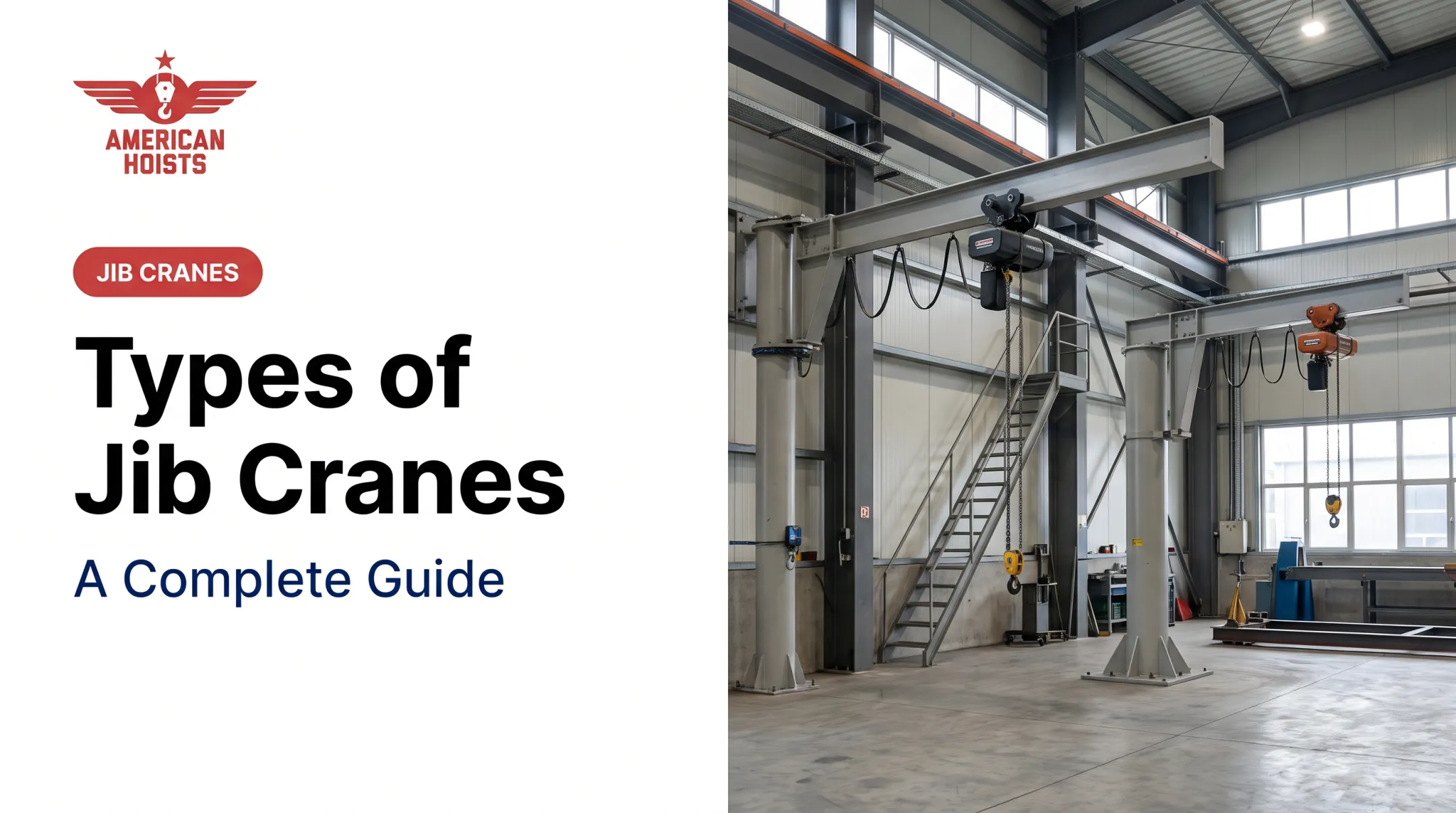
A jib crane uses a rotating arm-mounted hoist, either wall-mounted or floor-mounted, to cover a defined circular or semicircular work area.
American Hoists offers two configurations:
- Wall-mounted: 1/4 to 5 tons, up to 180-degree rotation
- Freestanding (foundationless): 1/4 to 1 ton, full 360-degree rotation
Both ship in roughly 10 days with at least 8 feet of lift height.
- Best for: Localized lifting tasks and tight workstation footprints
- Key strength: Fast to deploy with dedicated coverage at a single workstation
- Limitation: Limited reach radius, lower capacity than bridge or gantry systems
Workstation Cranes
These are lightweight, modular systems built for ergonomic, repetitive lifting—think assembly and packaging lines. Gorbel documents workstation systems spanning up to 30 feet, lifting 150 pounds to 2 tons.
- Best for: Assembly and packaging lines that need frequent, ergonomic lifts
- Key strength: Reduces operator strain, easy to reconfigure as layouts change
- Limitation: Not intended for heavy-duty industrial loads

Key Components of an Overhead Crane
Understanding these components helps you evaluate crane quality, durability, and the maintenance you'll need over time.
Bridge/Girder: The main horizontal beam (or beams) spanning the runway, supporting the trolley and hoist. Single-girder designs use one beam; double-girder designs use two for greater capacity and headroom.
Hoist: The lifting mechanism (wire rope or chain) that raises and lowers loads. American Hoists supplies both:
- Harrington NER chain hoists (1/8 to 20 tons), rated for 60 minutes of duty with H4 classification
- Harrington RY and Starke SMW wire rope hoists (3 to 15 tons), built with TEFC motors, Class F insulation, and IP55 protection for demanding service
Trolley: The wheeled carriage that travels along the bridge rails to position the hoist over the load.
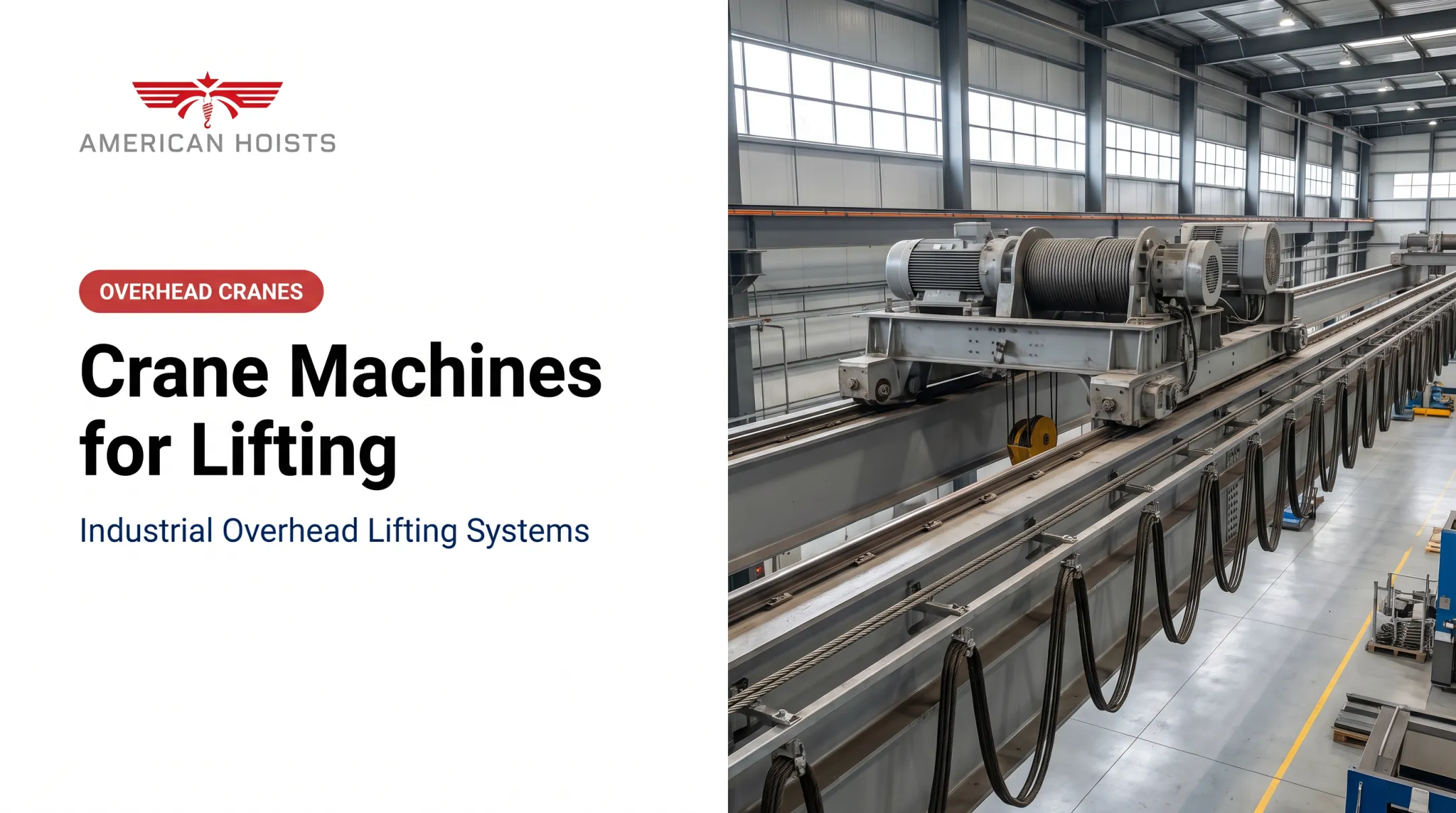
Runway and End Trucks: The rails and wheeled support structures that let the bridge travel the length of the facility. End trucks attach to the girder ends and carry the bridge along the runway.
Controls: Pendant, radio, or cab-operated systems that let operators manage crane movement and lifting. Most industrial facilities use pendant controls for close-range work and radio controls for larger bays.

How to Choose the Right Overhead Crane for Your Facility
The right crane depends on your layout, load demands, and daily operations, not on what's most common in your industry.
Weigh these factors before you buy:
- Load capacity and lift frequency – Match the crane to your heaviest routine load, not just occasional peaks
- Span, hook height, and overhead space – Measure your actual building dimensions before shopping
- Existing structure vs. freestanding support – Determine whether your building can support a runway or if you need a gantry-style setup
- Indoor vs. outdoor environment – Exposure affects motor protection and hoist selection
- Budget and scalability – Consider whether you'll need to expand capacity later
Once those requirements are clear, American Hoists offers crane kits in underhung (1-10 tons, 20-80 ft spans) and top-running (2-20 tons) configurations, typically shipping in 10 days. For anything outside standard specs, American Hoists' custom quote service connects you with hoist specialists who help spec the right crane-and-hoist combination for your application.

Conclusion
Overhead cranes keep material handling efficient across American manufacturing. Bridge, gantry, monorail, jib, and workstation cranes each solve different problems—and picking the wrong one costs you in safety, efficiency, or wasted budget.
Before finalizing your equipment, talk to an American Hoists specialist or request a custom quote. Getting the specification right the first time beats retrofitting later.
Frequently Asked Questions
What are the different types of overhead cranes?
The main types are bridge (single or double girder), gantry, monorail, jib, and workstation cranes. Each differs by support structure: runway-mounted, freestanding legs, fixed track, rotating arm, or modular design.
What are the different types of stationary and indoor overhead cranes?
Single and double girder bridge cranes are the most common stationary indoor options, running along fixed runways. Workstation cranes also serve indoor settings, offering lighter-duty, modular lifting for assembly and packaging lines.
What is the difference between a gantry crane and an overhead crane?
Gantry cranes stand on freestanding legs and don't require overhead runway support. Bridge (overhead) cranes rely on fixed runways mounted to the building structure or dedicated support columns.
What are the OSHA requirements for overhead cranes?
OSHA requires regular inspections at daily-to-monthly and periodic intervals, designated (qualified) operators only, and rated-load markings on every crane. Test loads can't exceed 125% of rated capacity unless the manufacturer specifies otherwise.
How much do overhead cranes cost?
Cost varies widely by type, capacity, and span. American Hoists' catalog ranges from a few thousand dollars for jib cranes to over $51,000 for larger crane and hoist systems. Request a custom quote for pricing specific to your application.
What is an overhead crane called?
It's most commonly called a bridge crane, referring to the horizontal bridge that travels along runways. The terms overlap in everyday industrial use, though "bridge crane" specifically describes that runway-mounted configuration.