
Introduction
Every overhead crane, monorail, and workstation lifting system in an American manufacturing facility depends on one core component: the hoist. It's the piece of equipment that actually raises and lowers the load, while the crane or trolley moves it horizontally.
Choosing the wrong hoist type doesn't just cost money. It costs production hours, creates safety risks, and can put you out of step with ASME B30 duty and inspection standards.
This guide breaks hoists down by power source and lifting medium. Then it walks through how to match the right type to your facility's actual needs—not just what's popular or cheapest.
Key Takeaways
- Hoists are classified by power source (manual, electric, pneumatic) and lifting medium (chain, wire rope)
- Electric chain hoists cover 1/8–20 tons; wire rope hoists typically handle 3–15+ tons
- Match the hoist to load, duty cycle, and environment—not brand familiarity
- ASME B30.16 sets hoist design, marking, and inspection requirements
- Mismatched equipment causes overheating, premature wear, and unplanned downtime
What Is a Hoist?
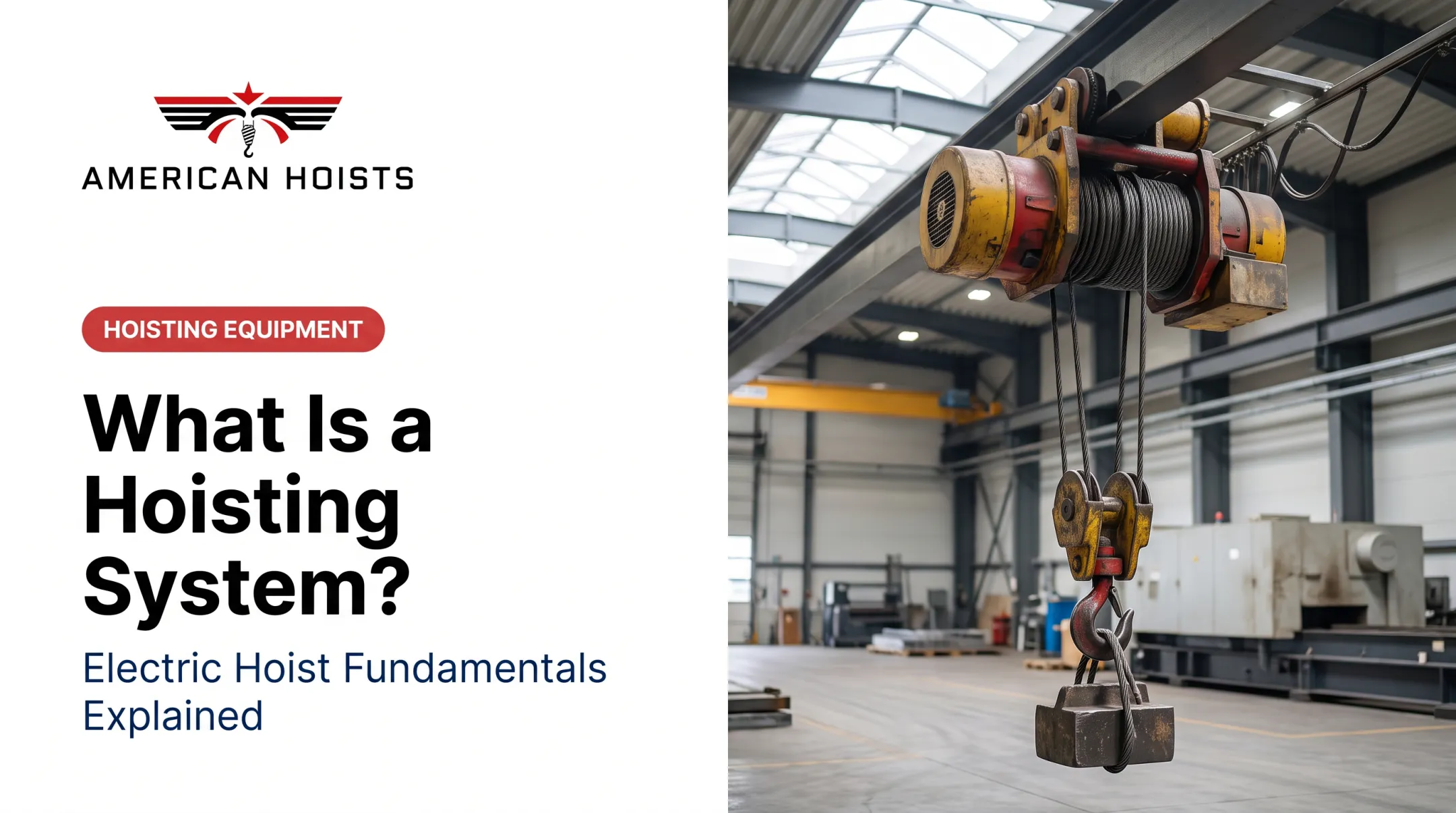
A hoist is a mechanical or powered device built to lift and lower loads vertically. Pair it with a trolley or crane bridge, and you get horizontal movement too. On its own, though, a hoist only does one job: vertical lift.
Strip any hoist down and you'll find four core components:
- Lifting medium - chain or wire rope that bears the load
- Motor or gear system - powers the lift (or, for manual units, the operator does)
- Load hook or block - connects the hoist to the load
- Control device - a pendant, lever, or button station that the operator uses
You'll find hoists doing the heavy lifting in manufacturing plants, warehouses, auto repair shops, and construction sites. They're built for daily industrial use, not occasional light duty.
Getting the type wrong causes real problems. An undersized motor overheats. A chain rated for the wrong duty cycle wears out fast. Operators get frustrated with slow cycle times, or worse, they get hurt.
There's no hoist-specific national injury database. The closest federal data shows crane-related work averaged 42 deaths per year between 2011 and 2017, according to the Bureau of Labor Statistics.
That figure covers cranes broadly, not hoist failure alone. Even so, equipment selection and ASME B30 compliance aren't optional—they're baseline requirements for safe lifting.
Types of Hoists by Power Source
Power source is usually the first fork in the road when you're specifying a hoist. It determines lifting capacity, speed, and how well the unit tolerates repeated use throughout a shift.
Manual Hoists
Manual hoists run on hand-chain or lever mechanisms. The operator turns a gear system by hand, no electricity or compressed air required.
These work best for:
- Low-frequency lifts where speed doesn't matter
- Remote sites without power access
- Maintenance bays and repair shops
- Smaller manufacturers with tight capital budgets
The upside is low cost, no utility hookup, and full portability. The downside shows up fast if you push a manual hoist into high-frequency work. Operator fatigue sets in, and practical lifting capacity drops well below what the spec sheet suggests.
American Hoists' catalog focuses on electric equipment—most production environments outgrow manual hoists once lift frequency climbs.
Electric Hoists
Electric hoists use a motor, activated through a pendant or remote control, to do the lifting. They can run on either chain or wire rope depending on the model.
This is where most production-line lifting happens. Electric hoists shine in repetitive tasks where speed and consistency matter more than upfront cost.
Duty cycle management is the catch. Continuous-run applications need a hoist rated for that kind of service, or the motor will overheat. American Hoists' Harrington NER chain hoist line, for example, carries a 60-minute duty rating and is H4 classified, with Class B insulation and thermal motor protection built in for demanding industrial use.
Once volume passes what a manual unit can handle, that mix of capacity and duty rating is why many facilities standardize on electric.
Pneumatic (Air) Hoists
Pneumatic hoists run on compressed air instead of electricity. Because air doesn't generate heat the way an electric motor does, these units self-cool during operation.
That makes them a natural fit for:
- Paint booths and spray finishing lines
- Chemical processing plants
- Food production environments
- Any washdown or spark-sensitive area
The tradeoff is infrastructure. Harrington's air-hoist documentation specifies a supply of 60-90 psi at 60-75 cfm, filtered down to 5 microns, with dry air maintained throughout the system, according to the manufacturer's owner's manual. Skip the filtration or dryer, and you're inviting corrosion and premature wear into an otherwise low-maintenance system.
Pneumatic hoists can run nearly nonstop without burning out—if the compressed air system behind them is sized and maintained correctly.

Types of Hoists by Lifting Medium
Power source is only half the picture. The second classification comes down to what actually carries the load: chain or wire rope.
Chain Hoists
Chain hoists feed a welded-link or roller load chain through a sprocket. Simple mechanism, proven design, and it's been the backbone of overhead lifting for generations.
They're the right call for:
- Shorter lift heights
- Compact installations with limited headroom
- Frequent, lighter-duty lifting cycles
American Hoists' Harrington NER series covers this ground with capacities from 1/8 ton up to 20 tons, across 13 standard capacity points. Lift heights run 10, 15, or 20 feet (customizable beyond that when a job calls for it).
These are American-made, three-phase units engineered for continuous industrial use. Most models ship in 2-4 weeks, and select 1/2-, 1-, and 2-ton models are available to ship immediately.
Chain hoists tend to be durable and easier to maintain than their wire rope counterparts. They're also generally louder and slower in operation, though that's rarely a dealbreaker for the applications they're built for.
Wire Rope Hoists
Wire rope hoists wind twisted steel strands around a drum instead of feeding a chain through a sprocket. That construction gives them greater tensile strength, which is why they show up in heavier-capacity, longer-lift applications.
Best suited for:
- High-capacity loads
- Extended lift heights (think 20 to 40 feet)
- Jobs requiring precise, sustained load positioning over time
American Hoists carries Harrington RY and Starke SMW wire rope hoists spanning 3 to 15 tons, with three-phase power in 230V or 460V configurations.
Ship times vary a lot by model: RY units generally ship next day (call to confirm), Starke SMW units in the 3- to 10-ton range ship in about a week, and the 15-ton Starke model runs a 10- to 12-week lead time.
Wire rope hoists cost more upfront and need more drum space than a comparable chain unit. In exchange, you get faster operation and the ability to handle heavier, longer lifts without the mechanical strain a chain system would face at that scale.

How to Choose the Right Type of Hoist
The right hoist matches your load, environment, and duty cycle. Competitor setups and the lowest price on the page rarely point to the same answer.
Check these factors before you specify anything:
- Load capacity and headroom — Rate capacity above your heaviest real load, then confirm lift height and headroom clearances fit the unit
- Duty cycle — Count lifts per hour, not only per shift. Occasional-use ratings fail quickly under near-continuous demand
- Environmental conditions — Washdown, extreme temperatures, and hazardous zones narrow options (pneumatic gear or specific electrical enclosures)
- Budget versus long-term cost — A cheap buy that drives chain replacements or motor burnout usually costs more within three years
- Power availability — No compressed air rules out pneumatic; no three-phase power limits electric hoist choices

Common Mistakes to Avoid
- Buying a 10-ton hoist for a 3-ton job wastes capital and adds headroom and mounting demands you do not need
- Running an H2-rated hoist at H4 cycle rates is a fast path to early motor burnout
- Skipping chain vs. wire rope upkeep comparisons upfront leads to maintenance budget surprises later
Conclusion
Hoists are the working core of safe, efficient lifting across American manufacturing and warehouse floors. Choose the wrong type and you take on avoidable downtime, safety risk, and premature wear. Choose well and the hoist simply does its job, shift after shift.
Different power sources and lifting mediums exist because different facilities have different needs. Load, duty cycle, and environment should drive the decision, not habit.
American Hoists supplies durable, American-made chain and wire rope hoists engineered for 24/7 industrial use, backed by specialist support to help confirm the right fit before you order. Whether you're outfitting a new line or replacing aging equipment, confirming fit before you order keeps production moving and cuts costly mis-buys.
Frequently Asked Questions
What are the different types of lifting hoists?
Hoists are classified by power source (manual, electric, pneumatic) and lifting medium (chain, wire rope). Each combination suits different capacities, environments, and duty cycles, so the right type depends on your specific application.
What is the difference between a chain hoist and a wire rope hoist?
Chain hoists suit shorter lifts and compact installations, generally at lower capacities. Wire rope hoists handle heavier loads and longer lift heights, with faster speeds but a higher price point and larger footprint.
What is the difference between manual and electric hoists?
Manual hoists are operator-powered, best for infrequent lifts or sites without power access. Electric hoists use a motor and controller, making them the better fit for repetitive, high-volume production work.
How much weight can a hoist lift?
Capacities range from a few hundred pounds for smaller manual units to over 100 tons for specialty heavy-duty models. Electric chain hoists commonly run 1/8 ton to 20 tons, while wire rope hoists typically span 3 to 15 tons or more.
How often should hoists be inspected?
Perform a visual check at the start of every shift. Schedule periodic in-depth inspections by service severity—quarterly for severe use, annually for normal service—per ASME B30.16 guidelines.
What ASME standard governs hoist safety and duty classification?
ASME B30.16 covers overhead hoist design, marking, and inspection requirements. Duty classification (H1 through H5) is a separate but related framework that determines how a hoist should be rated for continuous versus intermittent use.