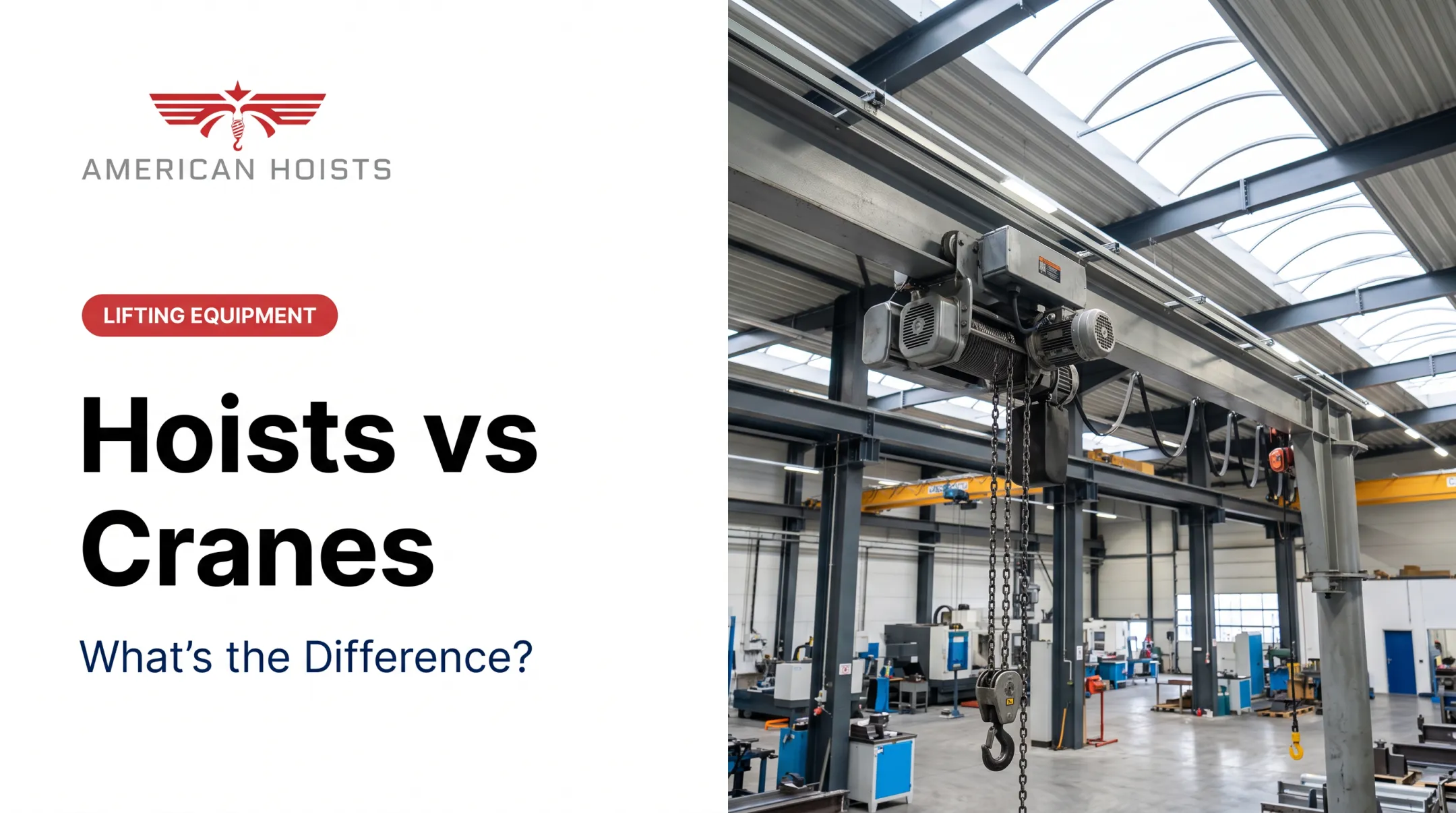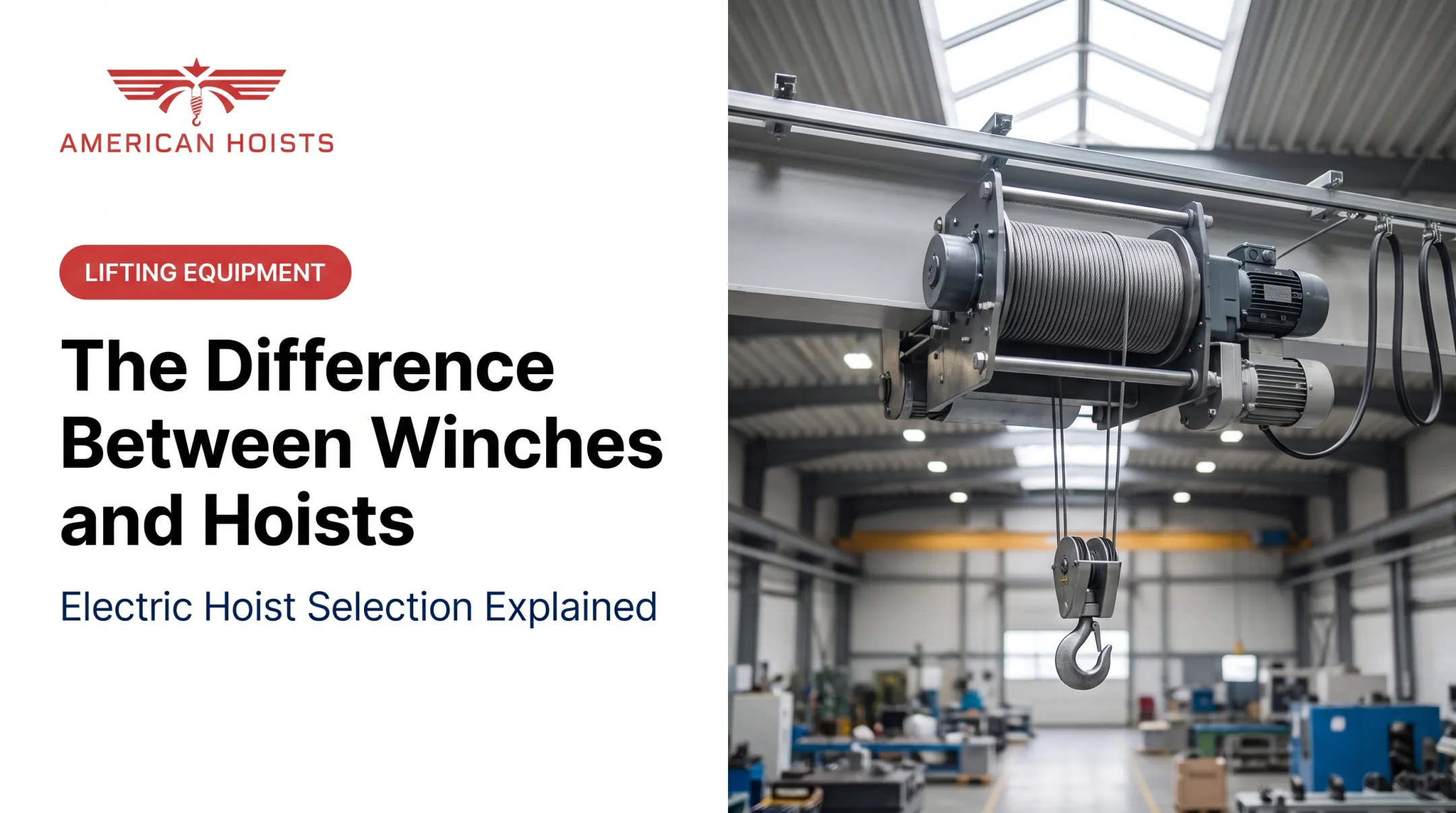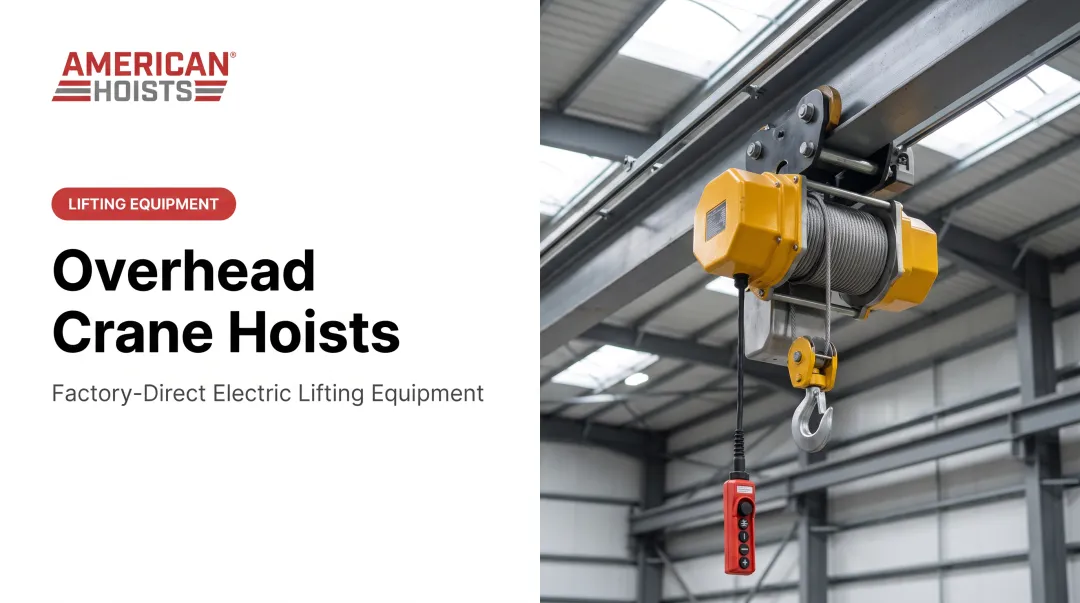

Order a standalone hoist when your operation actually needs multi-directional coverage, and you'll end up with bottlenecks, wasted floor space, and operators standing around waiting for equipment. Order a full crane system when a fixed-point hoist would've done the job, and you've overspent on structure you'll never use.
This guide breaks down what separates a hoist from a crane, where each one fits in a manufacturing facility, and how to choose the right equipment before you commit budget to it.
Key Takeaways
- A hoist lifts and lowers loads vertically; a crane adds horizontal travel across a work area
- Hoists are usually a component inside a crane system, not a competing product
- Choose based on load weight, facility layout, and whether material must travel horizontally as well as vertically
- American Hoists offers standalone chain and wire rope hoists plus full bridge crane systems rated for continuous 24/7 operation
Hoist vs Crane: Quick Comparison
Side by side, the practical differences look like this:
| Factor | Hoist | Crane |
|---|---|---|
| Movement | Vertical only | Vertical + horizontal |
| Cost | Lower upfront and maintenance | Higher investment, greater capacity |
| Installation | Minimal headroom, quick setup | Runway rails, end trucks, structural support |
| Typical capacity | 1/8 ton to 20 tons (chain); 3–15 tons (wire rope) | 1/8 ton to 10 tons (assembled bridge cranes), scaling much higher in custom systems |

OSHA definitions match the same split. Under 29 CFR 1910.179, a hoist is "an apparatus that may be part of a crane" used to exert lifting force. A crane is the full machine that lifts and moves loads horizontally. That single distinction drives almost every decision below.
What Is a Hoist?
A hoist does one job: raise and lower a load. It uses chain, wire rope, or cable, and it's powered manually, electrically, or pneumatically. It does not move the load horizontally on its own.
Chain hoists vs. wire rope hoists:
- Chain hoists — compact, cover a wider capacity range (typically 1/8 ton to 20 tons), and ship faster
- Wire rope hoists — built for heavier loads, longer lift heights, and more precise positioning over sustained periods
For example, American Hoists' Harrington NER chain hoist line runs 1/8 ton through 20 tons with a 2–4 week lead time. Its Harrington RY and Starke SMW wire rope hoists cover 3 to 15 tons, and several models ship next day.

Why a Hoist Makes Sense
A standalone hoist needs minimal headroom and installs quickly compared to a full crane. That makes it the obvious pick for fixed-point lifting stations where the load never needs to travel far.
Use Cases of Hoists
Hoists fit naturally into workflows built around one lifting point:
- Maintenance bays — lifting engines, transmissions, or heavy components in place
- Assembly stations — positioning parts at a single work cell
- Loading docks — spot lifts onto trucks or racks
You’ll typically find them in automotive service bays, general manufacturing workstations, and warehouses that need occasional spot lifts rather than full material transport.
The safety case here is ergonomic, not just operational. OSHA notes that ergonomic improvements reduce fatigue, increase productivity, and lower the frequency and severity of musculoskeletal disorders. Swapping manual lifting for a powered hoist at a fixed station is a direct application of that principle.
What Is a Crane?
A crane is the complete system: hoist, trolley, and bridge working together. The hoist lifts and lowers, and the trolley moves the hoist along the bridge. The bridge travels the runway rails, so you cover a rectangular work area instead of one fixed point.
Common crane types:
- Overhead bridge cranes — full runway systems for wide-area coverage
- Gantry cranes — freestanding, no permanent runway required
- Jib cranes — rotating arm for localized reach without full runway infrastructure
- Monorail cranes — single fixed rail for linear travel
American Hoists supplies systems that map to those setups:
- Fully assembled bridge cranes from 1/8 ton to 10 tons (chain hoist or wire rope)
- Crane kits (top-running and underhung) up to 20 tons
- Jib cranes from 1/4 ton to 5 tons

Use Cases of Cranes
Cranes earn their higher price tag when material has to move across a facility, not just up and down at one spot.
- Steel fabrication — repositioning heavy stock between cutting, welding, and finishing stations
- Heavy assembly lines — moving subassemblies between work cells
- Warehouse material transport — covering long spans between storage and shipping
A real-world example: Wells Concrete installed four twin-girder overhead cranes, each rated 25 tons with roughly 85-foot spans, to serve precast production. Operators could rotate components in place and skip repeated handling steps, which cut wasted motion from the process.
Hoist vs Crane: Which Is Better for Your Operation?
Five operational factors decide which equipment fits your floor:
- Load weight — Heavier, longer-duration lifts push you toward wire rope hoists or a full crane.
- Lift frequency — High-frequency, single-point lifts favor a standalone hoist.
- Facility headroom — Bridge cranes need runway clearance; hoists don't.
- Travel distance — If the load needs to cross the floor, you need horizontal travel—meaning a crane.
- Budget — Hoists cost less upfront; cranes cost more but unlock throughput across multiple stations.

The short version: Choose a hoist for fixed-point or single-station lifting in tight headroom—including high-frequency work at one location. Choose a crane when loads must travel across the floor or serve multiple stations.
American Hoists supplies both ends of that spectrum: heavy-duty bridge cranes, wire rope hoists, and chain hoists rated for continuous 24/7 operation. That range lets you match equipment to real production needs instead of guessing.
Real-World Application
Here's a scenario that plays out in plants across the country: a facility starts with a handful of electric chain hoists at fixed stations. Production volume climbs. Suddenly those same hoists can't keep up, because material now needs to move between stations, not just up and down at one.
That's the trigger point. Facilities often move through the same progression:
- Fixed-station hoists for vertical lifts at one bay
- A shared bridge crane once material must travel between stations
- Dedicated workstation cranes when operators start waiting on shared coverage
Gorbel documented a similar case at Quadco, where a single 5-ton bridge crane serving multiple workstations created a bottleneck. The plant added dedicated workstation crane cells so assemblers could work independently while the main crane handled only finished assemblies (Gorbel case study).
Woodward's Fort Collins facility saw the same pattern from the other direction: shared crane access meant operators waited their turn. Expanding from three bridges to nine, plus adding roughly 40 ceiling-mounted workstation cranes, gave each aisle dedicated coverage and removed the staging delays altogether.
The takeaway: matching equipment to actual workflow, not just tonnage, prevents wasted investment and avoidable delays.
If you're not sure whether your next equipment purchase should be a hoist or a full crane system, request a custom hoist quote from American Hoists. Our specialists will walk through your load, span, and workflow needs before you spend a dollar.
Frequently Asked Questions
Is a hoist considered a crane?
No. A hoist is the lifting mechanism, not the full crane structure. It's often mounted onto a crane's trolley and bridge to provide the vertical lifting power.
What is the main difference between an overhead crane and a hoist?
An overhead crane is the entire structure, including the bridge and runway, that moves loads horizontally along the bridge and runway. The hoist is just the component that actually lifts and lowers the load.
What is the difference between a hoist and a jib crane?
A jib crane is a full piece of equipment with a rotating arm that covers a fixed radius. A hoist is the lifting mechanism that mounts onto that arm, or onto any other crane structure.
How does OSHA define a crane?
OSHA classifies cranes under material handling equipment standards covering safe operation, load limits, and inspection requirements. Check OSHA's official standard for the full definitions and requirements.
Why do they call it a jib crane?
The name comes from the "jib," the projecting arm that rotates around a mast or support to move loads within a fixed radius.
What's another name for a hoist?
You may hear "lifting hoist," "electric hoist," or brand-specific model names. "Chain hoist" and "wire rope hoist" describe the lifting medium, not separate product categories from hoists themselves.