
Manufacturers still run into three recurring headaches: unplanned downtime when equipment fails, safety incidents tied to manual handling, and confusion over which crane system actually fits their building. A facility with a 20-foot ceiling and a 5-ton production need doesn't require the same setup as a shipyard moving 40-ton steel sections.
This guide breaks down how overhead cranes work, the main configurations available, what they cost, and the safety practices that keep operators and equipment running smoothly.
Key Takeaways
- Overhead cranes come in bridge, gantry, and jib/monorail setups for different loads and layouts
- Match capacity, duty cycle, facility structure, and span—not price alone—when you choose
- Expect a few thousand dollars for light jib systems up to $100,000+ for heavy double-girder bridges
- Structured inspections and OSHA-compliant practices stop most failures before they start
- American Hoists supplies 24/7-rated hoists and crane kits that help plants cut downtime
Understanding Overhead Cranes: Components and How They Work
An overhead crane lifts and moves loads horizontally along an elevated runway system fixed to a building's structure. That's the key distinction from mobile or construction cranes: OSHA defines it as a movable bridge carrying a hoisting mechanism, traveling on an overhead fixed runway structure. No wheels, no outriggers. Just a machine built into the facility itself.
Three Coordinated Motions
Every overhead crane relies on three movements working together:
- Bridge travel — the girder moves lengthwise along parallel runways, supported by end trucks on each side
- Trolley movement — the trolley and hoist travel laterally across the bridge
- Hoisting — the hoist raises and lowers the load vertically
End trucks and the runway system carry the weight of the entire bridge assembly, which is why building structure matters so much when sizing a crane.
Drive Systems and Hoist Types
Modern cranes use electric motors paired with variable-frequency drives (VFDs) to control acceleration and deceleration. That precision reduces jerky starts and stops that stress both the load and the structure.
Two hoist types dominate the industry:
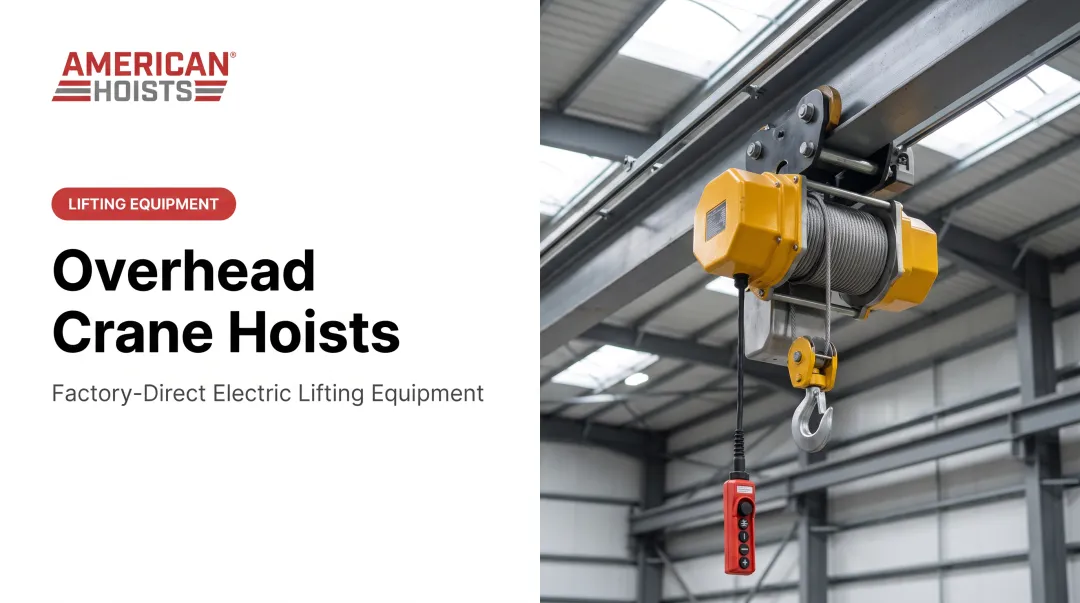
- Chain hoists — compact, cost-effective, typically used for lighter capacities
- Wire rope hoists — built for heavier loads and higher duty cycles
American Hoists' Harrington NER chain hoists cover 1/8 to 20 tons with a 60-minute duty rating and H4 classification. Harrington RY and Starke SMW wire rope hoists handle 3 to 15 tons for heavier, more continuous lifting demands. Matching hoist type to your actual workload, not just tonnage, keeps equipment from wearing out prematurely.

What Are the Three Types of Overhead Cranes?
The industry generally groups overhead lifting equipment into three configurations: bridge, gantry, and jib/monorail systems. Each solves a different combination of load, space, and building constraint.
Bridge Cranes
Bridge cranes are the workhorse of most manufacturing floors. They come in two structural types:
- Single girder — lighter, more compact, lower cost, typically suited to lighter capacity ranges
- Double girder — used when you need greater capacity, more lift height, or a service platform between the girders
They're also classified by how the bridge travels on the runway:
- Top running — end trucks ride on rails atop the runway beams, giving more usable hook height
- Under running (underhung) — end trucks ride on the lower flange of the runway beams, reducing overhead clearance needs but sacrificing some hook height
American Hoists supplies underhung and top-running crane kits from 1 to 20 tons, built for facilities that need continuous, heavy-duty operation without waiting months for a fully engineered system.
Gantry Cranes
Gantry cranes carry their bridge on freestanding legs instead of relying on the building's runway structure. That makes them a practical choice for:
- Outdoor yards and staging areas
- Shipyards and heavy fabrication sites
- Facilities without the structural capacity to support an overhead runway
If your building can't handle runway-mounted rails, a gantry solves the problem without modifying the building structure.
Jib and Monorail Cranes
Jib cranes are compact, rotating-arm systems ideal for a single workstation — think a welding bay or a machine-loading station. Monorail cranes, by contrast, follow a fixed path along a track, suited to repetitive, high-volume production lines where the same load path gets used over and over.
American Hoists' jib cranes come in two mounting styles: wall-mounted units (1/4 to 5 tons, 180-degree rotation) and foundationless freestanding units (1/4 to 1 ton, 360-degree rotation) — both shipping in 10 days.
How to Choose the Right Overhead Crane (and What It Costs)
Picking a crane starts with matching equipment to real operating conditions, not just budget.
Start With Load Capacity and Duty Cycle
A crane that lifts 5 tons occasionally has very different requirements than one running 5 tons continuously, eight hours a day. Duty cycle determines motor sizing, gearing, and expected service life. Get this wrong and you'll be replacing components far sooner than expected.
Assess Your Facility
Before selecting a system, check:
- Ceiling height and available hook height
- Whether the building structure can support a runway system, or whether a gantry makes more sense
- Indoor vs. outdoor operating environment
- Span and travel distance: enough to cover the work area, without oversizing and paying for capacity you'll never use
Realistic Cost Ranges
Costs vary enormously by configuration. According to Mazzella Companies' 2024 crane cost guide, typical new-system budgets look like this:
| Configuration | Typical Cost Range |
|---|---|
| Light-duty jib | $500 – $25,000 |
| Workstation/light bridge | $2,000 – $80,000 |
| Mid-range single girder bridge (5-ton example) | ~$40,000 |
| Heavy-duty double girder bridge | $65,000 – $100,000 |
| Engineered gantry | $130,000 – $170,000 |
| Monorail | $15,000 – $25,000 |
For comparison, American Hoists' current lineup runs from $2,500 to $6,995 for jib cranes, $19,000 to $25,500 for crane kits, and $3,430 to $51,450 for electric chain hoists. That gives buyers a whole-unit alternative without engineered-system pricing.

Lead Time Matters as Much as Price
A crane that's $10,000 cheaper doesn't help if it takes 12 weeks to arrive during a production crunch. American Hoists ships jib cranes and crane kits in 10 days, and its custom hoist quote service lets facilities engineers spec out non-standard lift heights or capacities without a drawn-out quote process.
Procurement Manager Lauren Brooks noted that previous vendors took weeks just to confirm lead times. American Hoists returned a quote and shipping confirmation within hours.
Key Benefits of Overhead Cranes in Manufacturing
Getting heavy loads off the floor changes how a facility operates.
- Keeps loads off the floor and away from workers, cutting strain-injury and crush risk
- Frees floor space for equipment, storage, or layout changes while lifting happens overhead
- Lets one operator move loads that would otherwise need a forklift and extra staff
- Steady material flow between work cells without tying up aisle traffic
Those gains show up on the floor every shift. Clearer aisles mean people and mobile equipment compete less for the same paths. Fewer manual lifts mean fewer injury claims. And when heavy staging no longer waits on a full crew, production keeps moving instead of idling on material handling.
Overhead Crane Safety Rules and Maintenance Best Practices
You'll sometimes hear operators reference a "3-3-3 rule" for crane lifts. That phrase is not an official OSHA or CMAA standard—no such rule appears in either body's published guidance.
What OSHA requires is more specific. When a load approaches rated capacity, the operator must raise it a few inches first and confirm the brakes hold before proceeding.
Inspection Cadence
Brake checks are only one piece of compliance. OSHA and CMAA both structure inspections around frequency of use, not a single fixed calendar date:
- Daily/pre-shift checks — visual and functional inspection before operation begins
- Frequent inspections — anywhere from daily to monthly, depending on component wear and exposure
- Periodic inspections — every 1 to 12 months under OSHA 1910.179, or quarterly to annually per CMAA guidance, based on duty cycle and environment
Hooks, hoist chains, and wire ropes require monthly inspection with a documented certification record — skipping this is one of the most common ways small wear issues turn into equipment failures.
Operator Training and Support
OSHA requires that only designated personnel—employees an employer has specifically assessed as qualified—operate covered cranes. Training should not stop at initial certification.
Ongoing competence matters as much as the first sign-off. Facilities that pair trained operators with responsive technical support catch problems earlier and avoid mismatched gear that leads to unplanned downtime. American Hoists' specialist consultation is built for that kind of application match when plants specify Harrington equipment.

Frequently Asked Questions
What are the three types of overhead cranes?
The main configurations are bridge, gantry, and jib/monorail cranes. Bridge cranes run on building-supported runways, gantries stand on freestanding legs, and jib/monorail systems serve single workstations or fixed production paths.
What is the 3-3-3 rule for cranes?
On the shop floor, “3-3-3” is informal shorthand some crews use for a quick pre-lift brake check—not an official OSHA or CMAA rule. OSHA’s actual requirement is to test brakes by lifting a near-rated load a few inches before the full lift.
How much do industrial overhead cranes cost?
Costs range from around $500 for light-duty jib systems to over $100,000 for heavy-duty double girder bridge cranes. Capacity, span, and duty cycle are the biggest cost drivers.
What is the difference between a bridge crane and a gantry crane?
Bridge cranes rely on the building's runway structure for support, while gantry cranes stand on their own freestanding legs. Gantries are the better fit for outdoor sites or buildings that can't support runway rails.
How much weight can an overhead crane lift?
Capacity ranges from under a ton for jib cranes up to 80 tons or more for heavy-duty double girder bridge systems, depending on configuration and service class.
How often should overhead cranes be inspected?
OSHA requires daily-to-monthly frequent inspections and periodic inspections every 1 to 12 months, depending on usage. CMAA guidance adds pre-shift checks plus periodic reviews from quarterly to annually based on service class.