
Here's where confusion often sets in: hoists, trolleys, and overhead cranes get used interchangeably, but they're not the same thing. Each plays a distinct role in a lifting system.
This guide breaks down what each component does, how hoisting mechanisms differ, and how to choose the right combination for your facility.
Key Takeaways
- A hoist lifts loads vertically; a trolley moves that hoist horizontally along a crane bridge or beam
- Match power source (manual, electric, or pneumatic) and lifting medium (wire rope or chain) to the job and environment
- Size the system by capacity, travel distance, and duty cycle before you commit to a hoist-trolley pair
- American Hoists supplies 24/7-rated hoists built to cut downtime for U.S. manufacturers
What Is a Hoisting System and What Is It Used For?
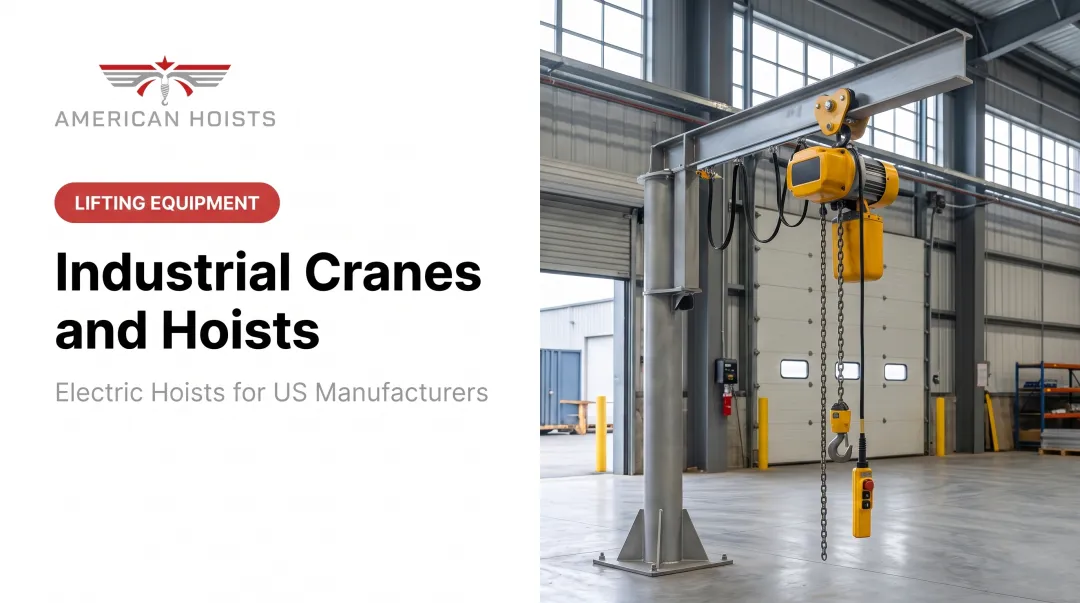
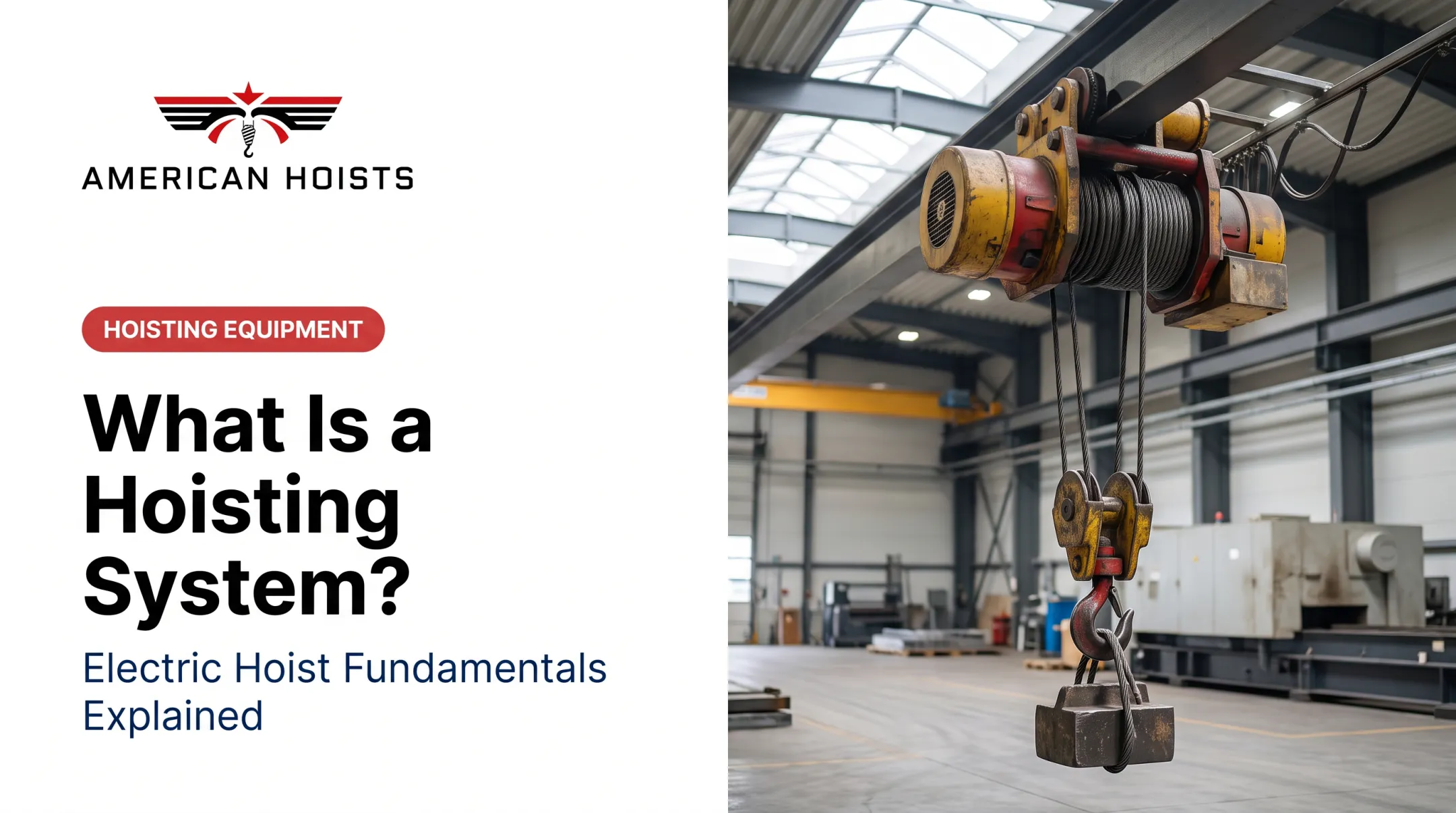
OSHA defines a hoist as "a mechanical device for lifting and lowering loads by winding a line onto or off a drum." Hoists rarely work alone. They're typically integrated into overhead cranes, jib cranes, or monorail systems, where the hoist supplies the vertical lift and other components handle horizontal travel.
The mechanical advantage comes from pulleys, gear reduction, and drum winding. A hoist rated for several tons can be operated with far less input force than the load itself, so one worker can safely move weight that would be impossible to lift by hand.
Common Applications on the Plant Floor
Hoisting systems show up wherever heavy materials need to move with precision:
- Assembly-line production, moving parts between workstations
- Loading and unloading trailers or railcars
- Staging work-in-process inventory
- General warehouse material movement
The Ergonomic Case for Mechanized Lifting
Manual material handling contributes to a large share of the more than 500,000 musculoskeletal-disorder cases reported annually in the U.S., according to NIOSH. OSHA notes that sound ergonomic practices, including mechanical lifting aids, can substantially reduce the frequency and severity of these injuries.
Industries That Rely on Hoisting Systems
- Automotive — assembly line and parts handling
- Construction — material staging and structural component placement
- Foundry operations — moving molds, ladles, and castings
- Heavy manufacturing — steel processing, fabrication, and machining
What Is a Trolley and How Does It Differ From a Hoist?
OSHA defines a trolley as "the unit which travels on the bridge rails and carries the hoisting mechanism." In plain terms:
- Hoist = vertical lift mechanism
- Trolley = horizontal travel carriage
The trolley is what turns a stationary hoist into a mobile lifting system, carrying it back and forth along a crane bridge or runway beam.

Plain Trolleys vs. Motorized Trolleys
Plain (push) trolleys are operator-propelled. A worker walks alongside the load and pushes it manually. That setup works well for lighter loads and occasional moves.
Motorized trolleys use an electric drive for powered horizontal travel. Choose them for:
- High-frequency operations
- Long travel distances
- Heavy capacity loads
- Multi-shift work where operator fatigue adds up
Mounting Configurations
Trolleys ride the beam in one of two ways:
- Top-running: wheels ride on rails on top of the beam. Preferred for greater lifting height and higher-capacity applications, sometimes 20 tons or more.
- Underhung: wheels ride on the lower flange of the beam. Common where building headroom is limited, and they typically have fewer tracking issues.
Structural strength of the building is a real constraint here. If the facility can't support a top-running system, underhung or freestanding configurations become the practical choice.

Together, the hoist and trolley cover vertical lifting and horizontal travel in one integrated system. Add bridge or runway motion and you get full bay coverage.
Types of Hoisting Mechanisms
Not all hoists work the same way. Power source and lifting medium determine where each type fits best.
| Type | Power Source | Best For |
|---|---|---|
| Manual/lever | Hand-operated | Light-duty, backup, no power available |
| Electric wire rope | Electric motor | Heavy industrial, continuous operation |
| Electric chain | Electric motor + chain | Mid-capacity manufacturing, cost-conscious buyers |
| Pneumatic/air | Compressed air | Explosive-risk or spark-sensitive environments |
Manual hoists raise and lower loads through a hand-operated chain or lever that drives a gear system. No electricity, no compressed air. They're the fallback option for locations without power access.
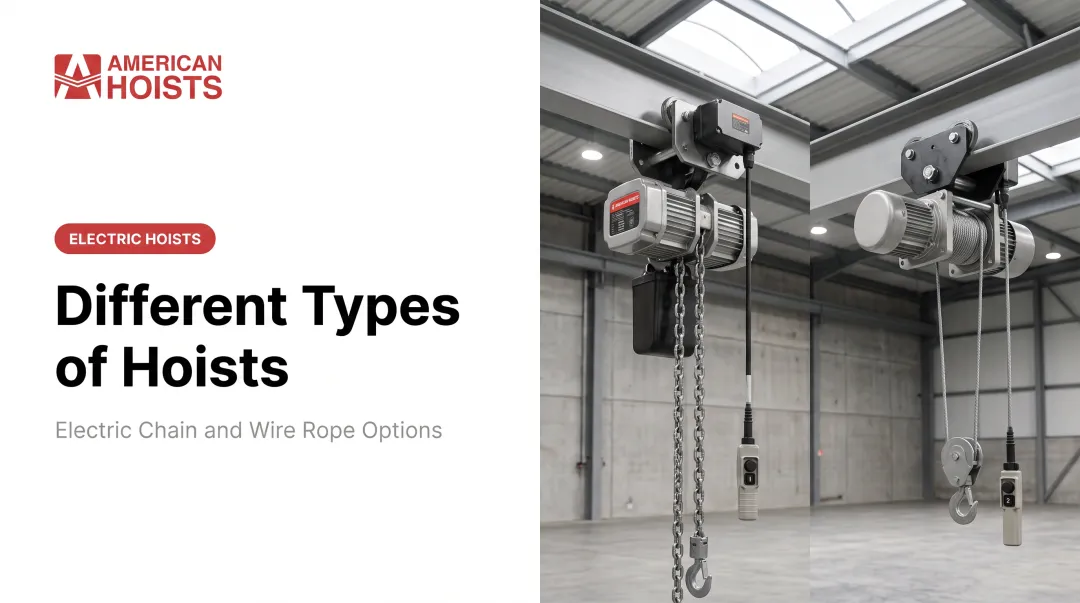
Electric wire rope hoists are the workhorses of heavy industrial settings. They handle higher capacities and longer lift heights than chain alternatives, which suits continuous production duty.
Electric chain hoists use link or roller load chain and tend to cost less than wire rope units. That balance makes them common for mid-capacity manufacturing tasks.
Pneumatic hoists run on compressed air instead of electric motors. That design matters where sparks from electrical components pose a real hazard.
When the job calls for continuous-duty electric lifting, Harrington's NER chain hoist line and RY wire-rope hoists, along with Starke's SMW series that we carry, are engineered for ASME H4-rated heavy industrial duty. That means Class F motor insulation, VFD control for smooth positioning, and IP55-rated protection against dust and water. Those specs support facilities running production around the clock.

Key Factors When Selecting a Hoisting System and Trolley
Getting the specification right upfront saves headaches later. Focus on these four factors:
Capacity and Travel Distance
OSHA requires rated load to be clearly marked on the equipment nameplate, and where multiple hoists share a system, each needs its own legible rating. Match capacity to your heaviest anticipated load, not your average one. Match capacity to your heaviest anticipated load, not your average one. Then size travel distance to the full trolley span and lift height your process needs—short runs waste floor coverage, and undersized lift height forces workarounds later.
Duty Cycle
Duty classification (H1 through H5) matches equipment to how often and how hard it runs:
- H1–H2: Infrequent use, light maintenance tasks
- H3: General machining, up to 25% running time
- H4: High-volume heavy loads, up to 50% running time, common in foundries and steel warehousing
- H5: Near-continuous bulk material handling

Headroom and Runway Compatibility
Headroom is the distance from the bottom of the beam to the hook saddle at its highest position. Low-headroom equipment maximizes hook travel where ceiling clearance is tight, especially in older plants.
Runway compatibility matters just as much: confirm beam type, flange width, and curve or end-stop layout so the trolley rides true without binding or custom modification.
Safety Features to Prioritize
- Overload protection: inhibits hoisting when load exceeds a preset percentage of rated capacity
- Upper limit switches: must be tested under no load at the start of each shift
- Self-setting holding brakes: engage automatically when power cuts out
Why American Manufacturers Choose American Hoists
American Hoists focuses on heavy-duty wire rope hoists, chain hoists, and crane kits engineered for continuous operation, not occasional light-duty use. That focus matters when downtime costs real money on a production line.
What sets the buying experience apart:
- Browse wire rope hoists filtered by capacity (3–15 tons), lift height, voltage, and shipping time
- Call a hoist specialist anytime at 817-779-4820, not a call-center script
- Get custom quotes when catalog options don't fit—specialists help you "spec it right"
One procurement manager reported receiving a quote and shipping confirmation within hours. Another maintenance supervisor said his replacement Harrington hoist arrived exactly as specified during a peak production week, shipped the next day.
New customers get $250 off their first hoist order by joining the American Hoists mailing list. Given that even a single chain hoist can run into the thousands of dollars, that's a meaningful discount for plant managers evaluating new equipment.
Frequently Asked Questions
How much does a jib crane cost?
Jib crane pricing starts around $2,500 for wall-mounted models and $5,000 for foundationless freestanding models, varying by capacity, span, and mounting type. Request a custom quote for accurate pricing based on your facility's specs.
What is hoisting used for?
Hoisting lifts and moves heavy loads across manufacturing, warehousing, and construction settings. Common applications include assembly-line production, material staging, and loading or unloading trailers.
What are the different types of hoisting mechanisms?
The four main types are manual/lever, electric wire rope, electric chain, and pneumatic/air hoists. Each suits different power availability, capacity needs, and environmental conditions like spark-sensitive areas.
What is the difference between a hoist and a trolley?
A hoist lifts and lowers loads vertically. A trolley carries that hoist horizontally along a crane bridge or runway beam. Together, they create full three-dimensional load movement.
What is a trolley on an overhead crane?
The trolley is the carriage unit that rides along the bridge rails and carries the hoisting mechanism. It can be operator-pushed (plain) or motorized for powered horizontal travel.
What is a ceiling hoist called?
Ceiling-mounted hoists are commonly referred to as overhead hoists or monorail hoists, depending on whether they run on a fixed beam system or a full crane bridge setup.