
Part of the confusion comes from how loosely "boom" and "jib" get used online. On a mobile crane, they're two different parts. In a fixed industrial setting, they usually describe the same rotating arm. That distinction matters if you're about to spend several thousand dollars on equipment for your floor.
This guide breaks down what a boom jib crane actually is, how it works, the main types available, and how to pair one with the right hoist for safe, continuous-duty lifting.
Key Takeaways
- A boom jib crane is a rotating horizontal arm on a mast, wall, or column — not a mobile crane accessory
- Capacity drops as reach increases; check the load chart at your working radius, not the max rating
- Wall-mounted jibs typically rotate 180 degrees; freestanding and mast-type units rotate 360 degrees
- Standard capacities span roughly 250 lb to 15 tons, from light assembly to heavy fabrication
- The hoist on the jib arm, not the arm itself, determines lifting performance and duty-cycle safety
What Is a Boom Jib Crane?
A boom jib crane is a lifting system built around a horizontal arm that rotates around a fixed vertical point, whether that's a mast, a wall bracket, or a support column. The arm carries a trolley and hoist, letting an operator move loads through a fan-shaped or circular work area without repositioning the whole machine.
Here's where the confusion starts: on fixed industrial equipment, "boom" and "jib" describe the same component. Manufacturers like Spanco and Konecranes use the terms interchangeably for that horizontal rotating arm.
OSHA's tower-crane regulations define things differently. A fixed principal horizontal structure is called a jib, while one that moves up and down is called a boom. That's mobile and tower-crane terminology, not the fixed workstation equipment most facilities are shopping for.
Boom vs. Jib: Key Structural Differences
On mobile cranes, the distinction is real: the boom is the primary telescopic or lattice arm bolted to the base or turntable, and it carries the bulk of the rated load. A jib is a secondary extension bolted to the boom's tip, built for lighter, small-radius handling.
In a fixed jib crane, that same trade-off shows up differently, as reach versus capacity:
- Extending the arm increases leverage on the mounting point
- More leverage means a lower safe working load
- The maximum capacity rating on the spec sheet almost never applies at maximum reach
Thern's stationary 5FT40 davit illustrates this well. It's rated for 5,500 lb at a 55-inch reach, but only 3,000 lb once extended to 122 inches. That's nearly a 50% capacity drop as working radius more than doubles. Never assume a jib crane's headline capacity applies at every position. Check the load chart at the radius you'll actually use.

Load Capacity Benchmarks and the Nautical Backstory
The word "jib" predates cranes entirely. It shows up in the 1660s as a term for a triangular foresail projecting from a ship's mast, a rigging term later borrowed for any projecting arm, cranes included.
As for capacity, industrial jib cranes span a wide range. Catalog data from Spanco shows a market span running from roughly 100 lb up to 15 tons, depending on configuration. Within that range:
- Wall-mounted jibs commonly top out around 5 tons
- Freestanding jibs can push toward the 15-ton ceiling
- American Hoists' own wall-mounted line runs 1/4 ton to 5 tons, with jib lengths up to 20 feet
That 100 lb to 15-ton figure isn't a "typical" rating. It's the breadth of the whole product category. Most facility installations fall somewhere in the light-to-mid range.
How Does a Boom Jib Crane Work?
A boom jib crane combines three systems: lifting, rotation, and (on some models) travel. Each is engineered separately, with its own safety limits.
Lifting (Hoist) Mechanism
The hoist mounted on the jib arm does the actual lifting. A motor drives a drum that spools wire rope or chain, raising and lowering the hook through a reduction gearbox for controlled speed.
Two safety features matter here:
- Brakes stop the load instantly and hold it in place, preventing free-fall if power cuts out
- Overload limiters cut power or trigger an alarm when a load exceeds the rated capacity, stopping the lift before damage occurs
Rotation Mechanism
A slewing bearing at the pivot point lets the arm sweep through its work envelope. Depending on the model, that's a gear ring and pinion setup, or a bearing with adjustable rotational resistance for smoother manual slewing.
Rotation range depends entirely on mounting style:
- Wall-mounted units: typically 180 degrees
- Freestanding and mast-type units: a full 360 degrees
Slewing limiters restrict the arm's rotation to a defined arc, often adjustable in small increments. That's a positioning control, not an overload protection. It stops the arm from swinging into a wall or piece of equipment, nothing more.
Travel Mechanism (Select Models)
Some jib cranes add wheels or a rail system, letting the entire unit reposition along a wall or runway. That expands the work envelope well beyond a single pivot point's fan-shaped radius.
Travel-equipped units need their own safety hardware. OSHA's crane standard requires trolley stops at the limits of travel, along with bumpers or an equivalent means of absorbing travel energy. Buffers prevent the trolley from slamming into end stops at full speed — a real concern on longer runway systems.

Types of Boom Jib Cranes
Different mounting styles suit different floor plans, budgets, and coverage needs.
Wall-Mounted (Wall-Bracket) Jib Cranes
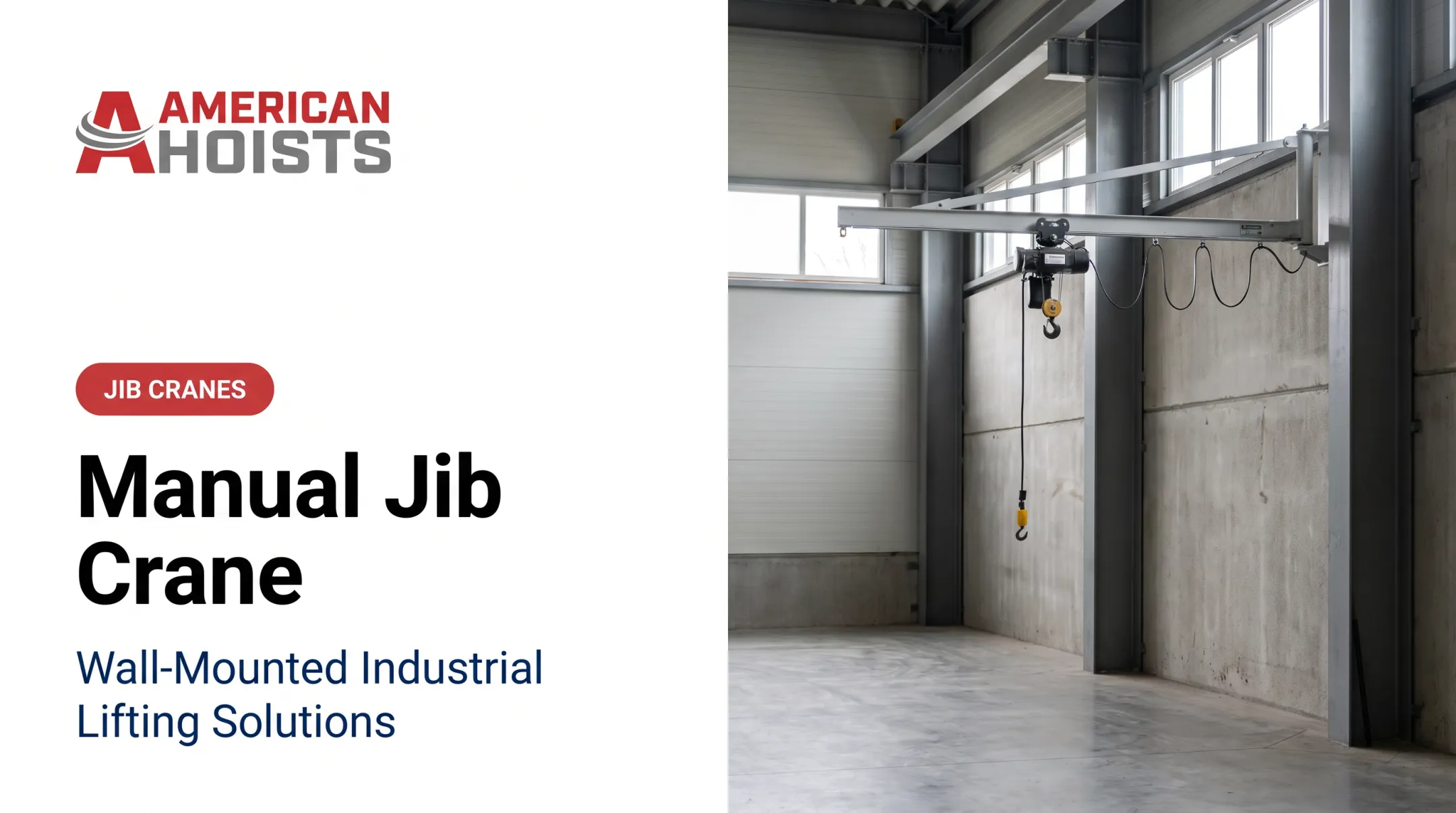
These attach directly to an existing building column or wall, saving floor space and skipping foundation work. American Hoists' wall-mounted line covers 1/4 ton to 5 tons, rotates 180 degrees, and reaches jib lengths up to 20 feet. They fit workstation lifting, load transfer, and light welding cells where floor space is tight.
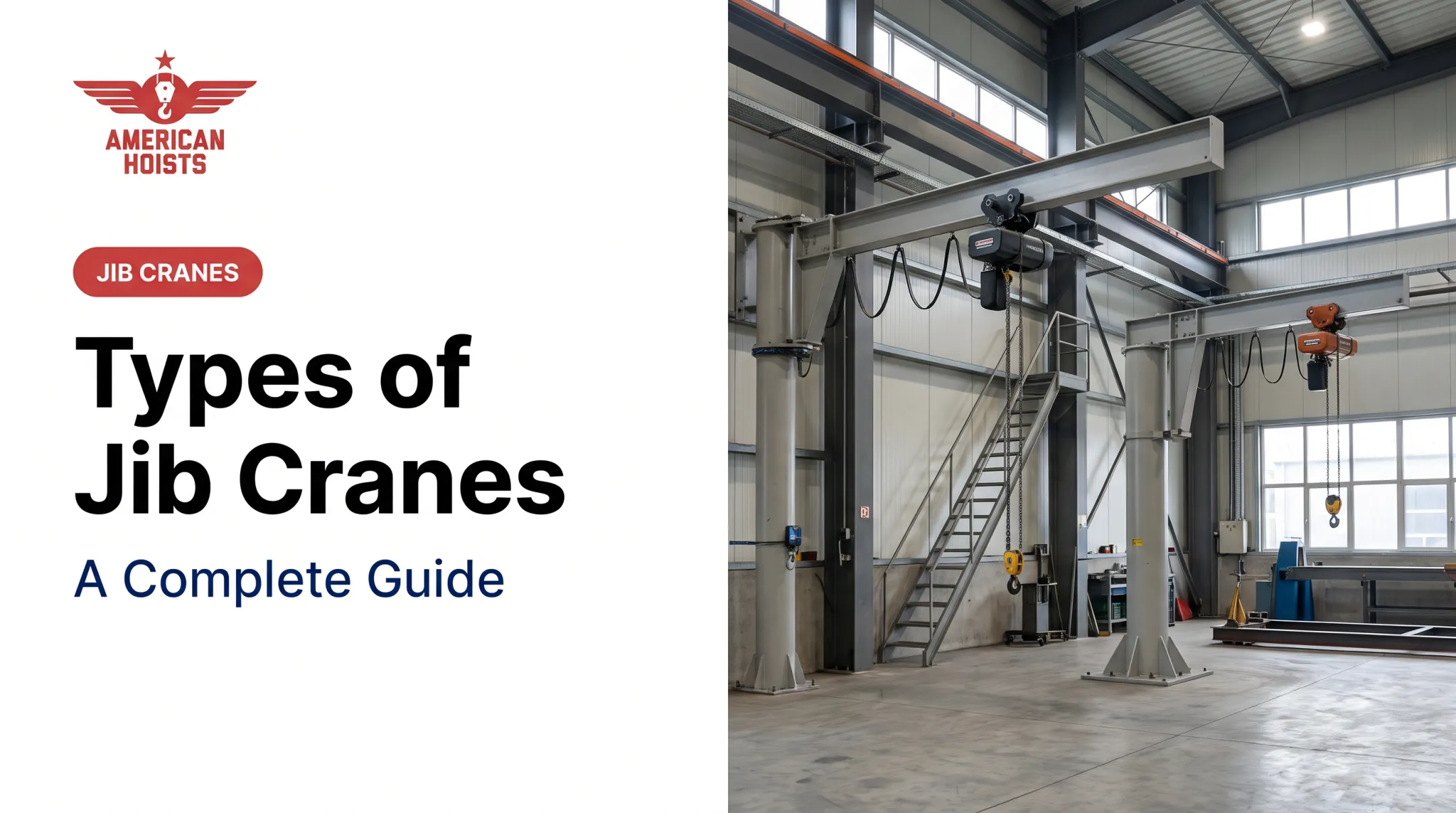
Freestanding Jib Cranes
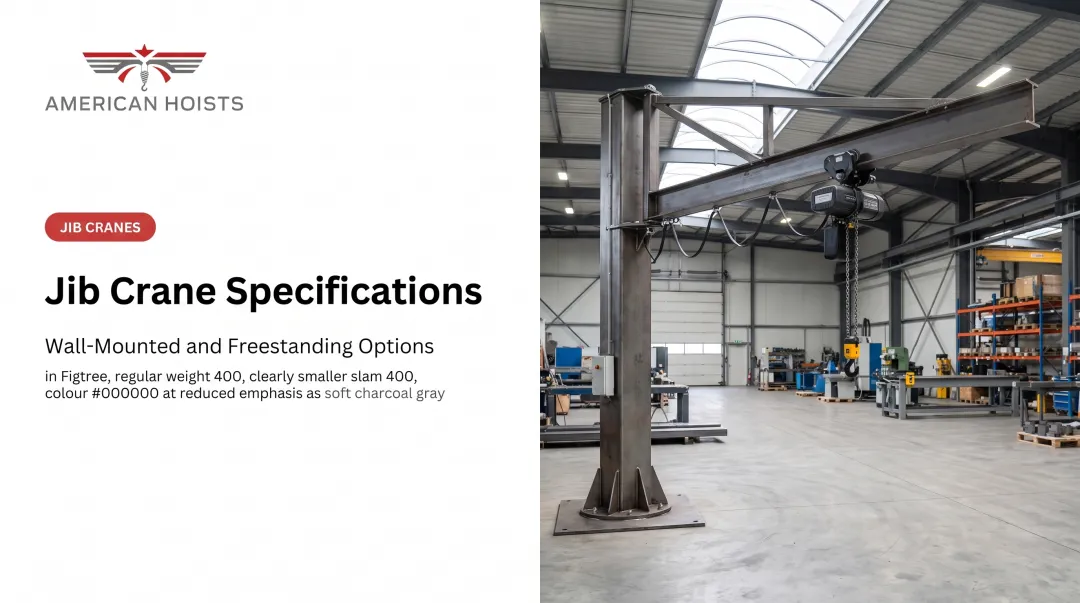
These mount on a base plate rather than a poured foundation and offer a full 360-degree sweep. American Hoists offers a foundationless freestanding model rated 1/4 ton to 1 ton, with jib lengths up to 16 feet—a practical option when you need full rotation without a permanent concrete pad.
Mast-Type Jib Cranes
A floor-supported mast with overhead bracing provides stability and 360-degree rotation without a heavy foundation. These are common in warehousing and general manufacturing.
Articulating (Knuckle) Jib Cranes
A two-arm, jointed design bends around columns, corners, or equipment. That reach pattern supports precise placement in cramped work cells.
Portable / Mobile Jib Cranes
These sit on a counterweighted, wheeled, or forklift-movable base. They suit temporary or light-duty jobs where a permanent install does not make sense.
Mobile Crane Jibs and Truck-Mounted Knuckle Booms
These sit outside fixed industrial jibs. They are secondary extensions bolted onto a mobile crane's boom tip or a utility truck's knuckle boom to add reach for construction and utility work.
Common Applications and Industries
Boom jib cranes earn their keep in settings where a bridge crane would be overkill and manual handling is too slow or risky.
- Manufacturing and assembly: Load and unload CNC machines; position heavy components at workstations without repetitive manual lifting
- Warehousing and logistics: Load trucks and sort long or bulky stock in aisles too narrow for a bridge crane runway
- Construction and maritime: Move materials on job sites, support engine-room maintenance, and install shipyard components in tight spaces
A manufacturer might put a freestanding jib rated around 500 lb beside a CNC cell. That one station change cuts load time and physical strain on high-frequency production runs.
Key Benefits of Boom Jib Cranes
The appeal comes down to three things: flexibility, cost, and durability.
- Flexible, precise operation: the rotating arm repositions loads within a fan-shaped area without moving the base equipment, ideal for repetitive workstation tasks
- Space-saving and cost-effective: a smaller footprint than a bridge or gantry crane, simpler installation, and lower ongoing maintenance than track-based systems
- Long service life: many years of dependable operation when the unit is installed correctly and inspected on a regular schedule
That last point comes with a caveat: service life isn't a fixed number. It depends heavily on duty cycle, environment, and how consistently anchors, wheels, and bearings get checked.
Choosing the Right Boom Jib Crane and Hoist Setup
Picking the right jib crane means matching four core factors to your application:
- Rated load with a safety margin — size for your heaviest anticipated load, plus buffer, not just today's average lift
- Working radius — check the capacity at your actual reach, not the crane's maximum rating
- Lifting height with clearance — account for headroom, obstructions, and hook travel
- Duty cycle — how many lifts per hour, and how continuously the crane runs
Environment matters too:
- Confirm your floor or wall can carry the load reactions
- Decide whether the unit sits indoors or outdoors
- Factor in corrosion resistance or temperature ratings for coastal or high-heat process areas
Why the Hoist Matters as Much as the Jib
The jib arm provides reach and rotation. The hoist is what actually determines lifting performance, speed, and safety margin day to day.
American Hoists pairs its wall-mounted and foundationless freestanding jib cranes (priced from $2,500 to $6,995, roughly a 10-day ship window) with American-made Harrington and Starke electric chain and wire rope hoists. These hoists are engineered for continuous 24/7 operation.

That pairing matters most in multi-shift facilities, where downtime from an undersized hoist costs far more than the equipment itself.
If your capacity, lift height, or duty cycle falls outside a standard configuration, American Hoists' custom hoist quote service lets you submit specs directly to a specialist. You get a proper fit instead of a guess, plus 24/7 support for facilities that can't afford unplanned downtime.
Frequently Asked Questions
What is the difference between a crane jib and a boom?
On mobile cranes, the boom is the main load-bearing arm connected to the base, while the jib is a secondary extension bolted to its tip for extra reach at lighter loads. On fixed industrial equipment, the two terms usually describe the same rotating arm.
What is a jib boom used for?
It extends horizontal reach and lets operators reposition materials within a work cell for precise, repetitive lifting, all without moving the base equipment. Common uses include machine loading, workstation assembly, and truck loading.
Why is it called a jib crane?
The term traces back to 17th-century sailing, where "jib" described a projecting foresail extending from a ship's mast. That "projecting arm" meaning later carried over to describe cranes with a horizontal projecting arm.
What is the typical load capacity of a jib crane?
Standard models range from 250 lb to 15 tons, depending on mounting style and configuration. Custom heavy-duty models can exceed that range for specialized applications.
What is the difference between a jib crane and an overhead bridge crane?
A jib crane covers a fixed fan-shaped or circular radius around its pivot point, ideal for localized tasks. A bridge crane travels the full length of a facility along runways, covering a much larger rectangular area.
What safety standards govern jib crane operation in the US?
Jib cranes fall under OSHA and ASME B30.17 requirements, which call for regular inspections, trained and designated operators, and functioning overload and rotation limiters. The attached hoist is separately covered under ASME B30.16.