
Many facilities face this same problem: tight budgets, no electrical infrastructure at the point of use, and lifting needs that happen a handful of times per shift rather than continuously. A powered crane system is overkill. A forklift is imprecise and often unavailable indoors. A manual jib crane splits the difference.
This guide covers what a manual jib crane actually is, how it stacks up against bridge and gantry systems, the main types you'll encounter, their core components, where they get used, and how to pick the right one for your shop.
Key Takeaways
- Manual jib cranes run on hand-chain or lever hoists, not electricity, cutting costs and infrastructure needs
- They cover a fixed radius rather than traveling across a facility like bridge or gantry cranes
- Mounting comes in three options: freestanding, wall-mounted, and mast-type
- They're built for occasional, moderate-to-heavy lifts, not high-speed repetitive cycles
What Is a Manual Jib Crane and How Is It Different From Other Cranes?
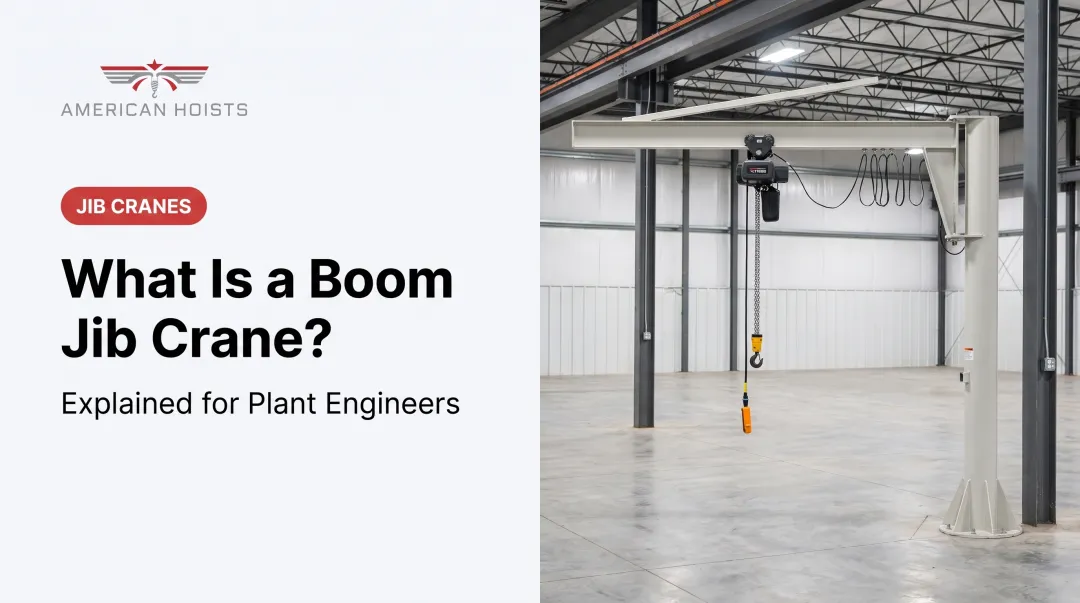
A manual jib crane is a boom-and-mast lifting structure operated by a hand-chain or lever hoist instead of an electric or pneumatic drive. The boom rotates on a fixed mast, wall bracket, or column, and the hoist rides a trolley along that boom.
How the hand-chain mechanism works: Pulling one chain drives internal gearing that lifts the load chain. The two chains do different jobs. One is the operator's input; the other carries the load. This double-reduction gear train is what lets one person lift several hundred pounds with modest hand effort.
Manual vs. Electric Jib Cranes
Manual units cost less upfront and need zero electrical infrastructure. The tradeoff is speed. According to Columbus McKinnon's hoist selection guidance, manual hand-chain hoists suit temporary or infrequent use, low capacities, and short lifts, while powered hoists fit faster, heavier, or higher-cycle work.
Manual Jib Cranes vs. Bridge and Gantry Cranes
Bridge and gantry cranes travel across a runway or monorail, covering an entire bay or aisle. A jib crane, manual or powered, stays put and serves a fixed circular or semi-circular radius around its mast or wall mount.
ASME B30.17 groups bridge cranes, gantry cranes, and jib cranes together as hand- or power-operated systems, but the structural coverage differs sharply. If you need to move a load 80 feet across a shop floor, a jib crane isn't your answer. If you need to service one workstation reliably, it usually is.

Typical specs to expect:
- Rotation: 180° (wall/column mounts) to 360° (freestanding/mast mounts)
- Capacity: a few hundred pounds up to several tons
- Best fit: maintenance shops, machine loading stations, low-frequency lifts where power isn't available or isn't worth running
Types of Manual Jib Cranes
Freestanding Manual Jib Cranes
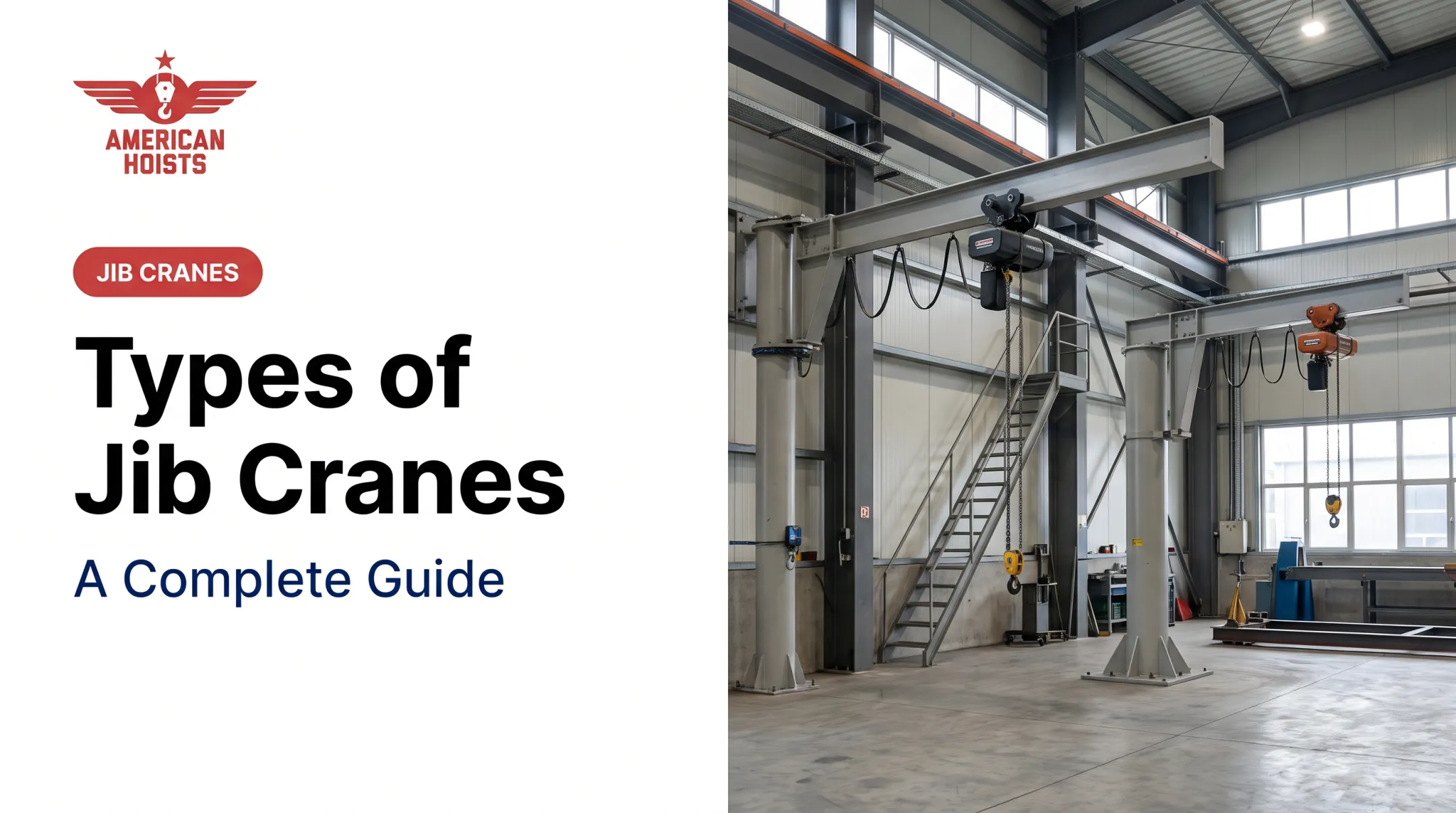
Freestanding jibs mount to a base plate, foundation, or removable sleeve insert, giving them full 360-degree rotation. That's the appeal: you can position one almost anywhere on the floor and get complete circular coverage.
American Hoists' foundationless freestanding jib crane line ranges from 1/4 ton to 1 ton (500 to 2,000 lbs), with jib lengths and lift heights up to 16 feet. Foundationless models simplify install versus poured-foundation units: the crane arrives fully assembled with engineering documentation.
Wall-Mounted Manual Jib Cranes
Wall-mounted jibs anchor directly to an existing building structure, which means:
- No floor space consumed
- No foundation work required
- Typically 180-degree rotation rather than a full circle
This makes them a strong fit for narrow shops or aisles where floor real estate is tight.
American Hoists' wall-mounted jib crane covers 1/4 ton to 5 tons (500 to 10,000 lbs), with jib lengths up to 20 feet. That range suits facilities that already have usable wall or column structure.
Mast-Type and Portable Manual Jib Cranes
Mast-type jibs bolt to the floor and to building steel above. A ceiling tie adds stability while still delivering full 360-degree rotation.
Portable models sit on a counterweighted base and can move as workflow shifts. Check stability and floor condition at every new position.

Key Components of a Manual Jib Crane
Every manual jib crane, regardless of mounting style, shares the same core parts:
- Boom (jib arm): The horizontal member the hoist travels along; its length sets your working radius
- Mast or mount: Vertical support, whether a floor-anchored mast, wall bracket, or ceiling tie
- Hoist: Hand-chain hoist for straight vertical lifts, or lever hoist for precise positioning and angled pulls
- Trolley: A manual push-pull unit that lets the hoist slide along the boom
- Rotation stops: Mechanical blocks that limit boom sweep to prevent collisions with walls or equipment
Hand-chain and lever hoists handle the load differently. Harrington's product documentation describes hand-chain hoists with double-reduction gearing, double pawls, and a slip clutch that protects against overload.
Lever hoists use a short handle with a recovery stroke and a Weston-style load brake, per ASME B30.21 standards for lever hoists. If your work involves tensioning or pulling at an angle, not just straight-up lifting, a lever hoist usually wins.
Safety note: Rotation stops prevent boom sweep collisions. They are not rated for side-loading or wind resistance, so never rely on them to control a swinging or angled load.

Common Applications of Manual Jib Cranes
Manual jib cranes fit best where lifting is necessary but infrequent, and power isn't guaranteed:
- Maintenance and repair bays — engine, gearbox, or component handling where lifts happen a few times a shift, not continuously
- Small machine shops — loading and unloading CNC machines or lathes without running new electrical circuits
- Assembly workstations — light-duty, repetitive component positioning near a fixed bench
- Remote or outdoor sites — locations lacking reliable power where a hand-chain hoist is the only practical option
Hand-chain hoists still make sense where power is unreliable or restricted, including remote yards and hazardous areas. Many plants keep one manual unit as backup even after powered lifting is installed elsewhere on site.
How to Choose the Right Manual Jib Crane
Selecting the right manual jib crane comes down to five practical checks:
- Determine your load capacity. Include rigging weight, not just the bare load, and build in a safety margin for future needs. Never exceed the nameplate rating of the crane, hoist, or trolley.
- Map your boom length, rotation, and clearance. A 16-foot jib with 360° rotation covers a very different footprint than a 20-foot wall-mounted unit with 180°. Measure your actual workspace before choosing.
- Pick your mounting style based on floor space and structure. Freestanding needs floor area and a base plate or foundation; wall-mounted needs a structurally sound wall or column; mast-type needs both floor anchoring and a ceiling tie point.
- Match the hoist to your lifting frequency. Hand-chain or lever hoists work for occasional vertical lifts and tight positioning. For repetitive or multi-shift duty, pair the jib with an electric chain hoist rated for continuous use.
- Get a quote built around your facility, not a catalog spec. Jib crane capacity, boom length, and mounting style interact in ways that are hard to nail down from a spec sheet alone.

American Hoists carries wall-mounted jib cranes from 1/4 ton to 5 tons and foundationless freestanding models from 1/4 ton to 1 ton, built for continuous industrial duty and typically shipped in about 10 days.
Specialists walk through capacity, boom length, and mounting with you directly. A custom quote request is the fastest path to the right configuration for your bay or workstation.
Frequently Asked Questions
What is a manual jib crane and how is it different from other cranes?
A manual jib crane uses a hand chain or lever hoist instead of electric power to lift and position loads. Unlike bridge or gantry cranes, which travel across a runway covering a whole facility, a jib crane serves a fixed radius around its mast or wall mount.
Can a manual jib crane lift heavy loads?
Manual jib cranes typically handle light to moderate loads, ranging from a few hundred pounds up to around 5 tons depending on the model. They're built for occasional lifts, not high-frequency heavy-duty cycles.
What is the difference between a hand chain hoist and a lever hoist?
A hand chain hoist uses continuous chain pulling for straight vertical lifts. A lever hoist uses a ratchet handle, giving you more control for lifting, pulling, and precise positioning at angles.
Do manual jib cranes require electricity?
No. Manual jib cranes run entirely on hand power, making them ideal for shops, remote sites, or outdoor areas without accessible electrical infrastructure.
How much rotation does a manual jib crane offer?
Most manual jib cranes offer 180° to 360° rotation. Wall-mounted units typically max out at 180°, while freestanding and mast-type units usually deliver a full 360°.
Where are manual jib cranes commonly used?
Manual jib cranes are common in maintenance shops, small machine shops, assembly workstations, and remote or outdoor sites where lifting needs are infrequent and power isn't readily available.