
OSHA defines a hoist specifically as an apparatus that exerts force for lifting or lowering, and separate ASME standards govern each category: B30.7 for winches, B30.16 for hoists. That's not bureaucratic hairsplitting. It reflects a real engineering difference in how each machine is built and braked.
This guide breaks down what separates winches from hoists, where each one belongs on a manufacturing floor, and how to decide which your operation actually needs.
Key Takeaways
- Winches pull horizontally or on an incline; hoists lift vertically
- Mechanical holding brakes rated for suspended loads are required on hoists; most winch brakes aren't
- Chain drives most hoists; winches run on wire rope or synthetic rope
- A properly rated winch can sometimes double as a hoist, but never the reverse
- Your choice depends on load direction, space, frequency, and safety requirements
Winch vs Hoist: Quick Comparison
| Factor | Winch | Hoist |
|---|---|---|
| Direction | Horizontal or inclined pulling; vertical only if specifically rated | Vertical lifting/lowering only |
| Braking | Dynamic/gear-based; not automatically suspension-safe | Mechanical load-holding brake, built for continuous vertical support |
| Line type | Wire rope or synthetic rope on a drum | Chain (most common) or wire rope with lift-wheel mechanisms |
| Footprint | Floor, wall, or ceiling mounted; larger footprint | Positioned directly above the load; compact |
| Duty | Long-distance pulls, variable capacity | Frequent, repetitive vertical lifts, continuous-duty rated |
The braking distinction matters most. Under OSHA's 1910.179, crane hoists need a self-setting holding brake that applies automatically when power cuts out, plus control braking to prevent overspeed during lowering. A winch built to pull a cart across a warehouse floor was never engineered or certified for that job.

What Is a Winch?
A winch pulls or positions a load by winding rope around a rotating drum. It's a workhorse for material transport where the load stays on the ground, on wheels, or on a track rather than hanging freely in the air.
Core strengths:
- Versatile across horizontal, inclined, and (when rated) vertical pulls
- Handles long-distance load movement that a fixed hoist can't reach
- Available in hand-crank, electric, hydraulic, and pneumatic configurations
Winches show up wherever something heavy needs to be dragged, not lifted: positioning steel carts, pulling machinery into place, or moving loads at the loading dock.
Use Cases of Winches
Winches earn their keep in construction, logistics, oil and gas, and heavy manufacturing, anywhere a load needs to travel across a surface under controlled tension.
A Minnesota wastewater treatment plant processing 1.3 million gallons per day needed to position steel sludge carts weighing up to 3,700 lb for uniform loading. A wall-mounted electric 4WS winch handled the pulls, and according to Thern's case study, the change cut loading time and labor.
That is the winch's job: guided, controlled pulling along a surface, not free-hanging lift.

What Is a Hoist?
A hoist exists for one job: lifting and lowering a freely suspended load, vertically, with precision and control. Unlike a winch dragging something across a floor, a hoist holds weight in the air — which is exactly why its braking system is engineered differently.
Core strengths:
- Precise vertical control for repetitive lifts
- Safety-rated braking built for suspended loads
- Designed for high-frequency use without excessive wear
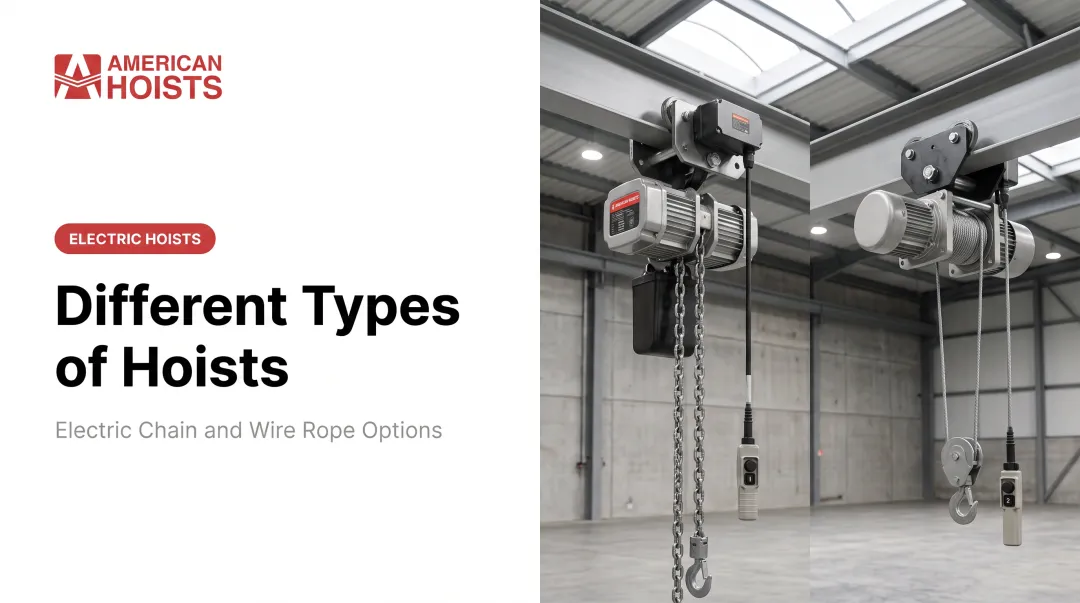
Variations include wire rope hoists, chain hoists, and both electric and manual designs — though electric units dominate manufacturing settings where repetition and reliability matter.
Use Cases of Hoists
Hoists are the backbone of overhead cranes, production lines, and warehouse material handling.
A CMAA-documented case at Wells Concrete shows the impact: four 25-ton overhead crane systems with twin hooks let operators lift, reposition, and rotate concrete products with far fewer manual handling steps, according to CMAA's manufacturing case studies.
American Hoists supplies both categories for this exact application:
- Harrington NER Series chain hoists, from 1/8 to 20 tons, built with Guardian Smart Brake technology and a 10-year brake warranty
- Harrington RY and Starke SMW Series wire rope hoists, spanning 3 to 15 tons, for heavier overhead lifting
Duty rating matters here too. Classifications like H4 (high-volume, heavy load) tell you how much continuous service a hoist can actually handle, not just its maximum weight rating.

Winch vs Hoist: Which Should You Choose?
Four questions settle most equipment decisions:
- Which way does the load travel? Horizontal or inclined → winch. Straight up and down → hoist.
- How often does it happen? Occasional positioning favors a winch; repetitive daily lifts demand a hoist rated for that duty cycle.
- How much space do you have? Winches need floor or wall clearance; hoists sit compactly overhead.
- Is the load ever freely suspended? If yes, you need documented holding-brake certification — a hoist, not a repurposed winch.
Simple rule: horizontal or long-distance pulling calls for a winch. Frequent, safety-critical vertical lifting on a factory floor calls for a hoist.
Real-World Application in Manufacturing
Picture a mid-sized fabrication shop using a wall-mounted winch to lift finished parts onto a staging platform. It works until it doesn't. The winch's dynamic brake, never rated for holding a suspended load, starts slipping under repeated cycles. A near-miss incident during a shift change forces the plant to shut the line down and reassess.
The fix: swapping the winch for a properly rated electric hoist with a mechanical holding brake designed for continuous vertical duty. Once installed, operators get automatic load-holding on power loss and a documented duty rating that matches actual usage.
Making the switch early matches the tool to the task and prevents the same failure from recurring:
- Reduced unplanned downtime from equipment not rated for the job
- Improved OSHA compliance through documented braking specs
- Fewer manual workarounds that slow production
Match the equipment to the application type first. That choice protects workers and keeps production schedules intact.

If you're mid-decision on a similar switch, American Hoists offers custom hoist quotes tailored to your lift height, capacity, and voltage requirements — plus $250 off your first hoist order. Talk to a specialist before you buy, not after something breaks.
Conclusion
Winches and hoists solve different problems. Winches pull and position loads horizontally or on an incline. Hoists lift and hold loads vertically, with braking systems built specifically for that job.
Neither should substitute for the other in safety-critical settings. The standards exist for a reason.
Get this decision right, and the payoff is fewer safety incidents, less unplanned downtime, and equipment that lasts through its full rated service life.
Frequently Asked Questions
Can a winch be used as a hoist?
Only if the winch has proper mechanical load brakes specifically rated for vertical, suspended-load use. Most standard winches use dynamic brakes not designed to hold a load safely in the air.
What's the difference between a hoist and a winch?
A winch pulls loads horizontally or on an incline using a drum-wound rope. A hoist lifts and lowers loads vertically using a mechanical holding brake rated for suspension.
What is a hoist and what is a winch?
In industrial settings, a hoist handles overhead work such as loading machines, positioning molds, or moving parts on a production line. A winch is typically used for dragging equipment, vehicle recovery, or tensioning along the ground or a ramp.
What brand of winch is the best?
Quality depends on your application: check duty rating, brake type, and line material (wire rope vs. synthetic) before comparing brands. The right winch for a loading dock isn't necessarily right for an oil rig.
Is winch rope as strong as cable?
Modern synthetic rope, like AmSteel Blue, can match steel cable's strength at a fraction of the weight when properly rated and used. Always confirm the manufacturer's safety factor for your specific application.
Is it legal for one person to use a hoist?
OSHA's 1910.179 doesn't set a blanket one-operator rule, but it does require that operators never leave the controls while a load is suspended. Follow your equipment's manual and your site's documented safety procedures.