
The confusion is understandable. A hoist is often part of a crane, which makes the two feel interchangeable. They're not.
Getting this wrong affects your budget, your installation timeline, and how fast your production line actually moves. This guide breaks down what separates a hoist from a crane, where each one fits in a manufacturing facility, and how to decide which one your operation actually needs.
TL;DR
- A hoist lifts and lowers loads vertically only; a crane adds horizontal movement across a workspace
- Hoists cost less upfront and install faster; cranes deliver full-range coverage for larger operations
- Most crane systems use a hoist as a component — the two are not competing products
- Choose based on load weight, facility layout, lifting frequency, and budget
Hoist vs Crane: Quick Comparison
| Factor | Hoist | Crane |
|---|---|---|
| Movement | Vertical only | Vertical + horizontal |
| Cost | Lower upfront and maintenance | Higher capital cost |
| Installation | Fast; minimal headroom | Runway rails, end trucks, bridge girders |
| Capacity | Hundreds of lbs to 20+ tons (chain), 30+ tons (wire rope) | Tens to hundreds of tons by configuration |
| Best fit | Fixed-point lifts, small shops, maintenance bays | Production lines, large-scale material handling |

Typical installed costs show how fast that gap grows, per Mazzella's overhead crane cost breakdown:
- 2-ton, 20-ft monorail: about $15,000–$25,000
- Double-girder bridge crane: about $65,000–$100,000 installed
- Full gantry systems: up to about $170,000
Span, runway length, and structural reinforcement drive most of that variance.
What Is a Hoist?
A hoist is the mechanism that raises and lowers loads along a vertical plane, using chain or wire rope. OSHA defines it simply: an apparatus that exerts force for lifting or lowering, which may exist on its own or be mounted as part of a crane.
For manufacturers, hoists solve point-of-use lifting problems. They have a compact footprint, need less headroom, and typically install in weeks rather than months—so you get vertical lifting capacity without a major floor-plan overhaul.
Types of Hoists
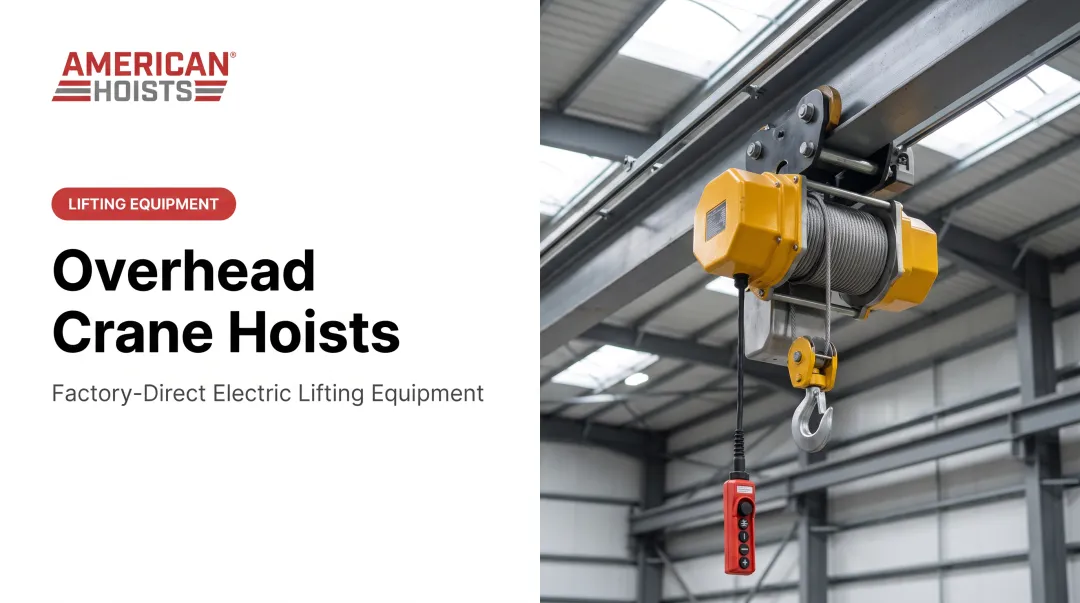
- Electric chain hoists — Compact, precise, and common for station-level lifts; capacities often run from fractional tonnage up through multi-ton work
- Electric wire rope hoists — Better for heavier loads and longer lifts, especially above about 5 tons and in higher-duty applications
- Manual chain hoists — Still used industry-wide for infrequent, portable lifts where speed matters less (American Hoists focuses on electric models)
American Hoists supplies Harrington electric chain hoists from 1/8 to 20 tons and Harrington RY and Starke SMW wire rope hoists from 3 to 15 tons, with lead times measured in days to a few weeks depending on configuration.

Where Hoists Fit in a Manufacturing Facility
Hoists dominate loading docks, assembly stations, and maintenance bays where the load only needs to go up or down. General manufacturing, automotive assembly lines, and warehouse maintenance areas rely on them heavily.
A clear example: Interroll's Wilmington, North Carolina plant needed to insert tube assemblies vertically into a mold without damaging linings or blocking the floor. A 1-ton ceiling-mounted monorail with an electric chain hoist handled the lift. Per the Gorbel case study, the setup sped production, cut awkward manual rigging, and kept floor space open.

That same point-of-use pattern shows up when facilities need a specific lift height or duty cycle. James O'Neill, Facilities Engineer at Atlas Components Inc., noted that American Hoists helped his team "choose the right wire rope hoist for a custom lift height," with the unit arriving on schedule.
What Is a Crane?
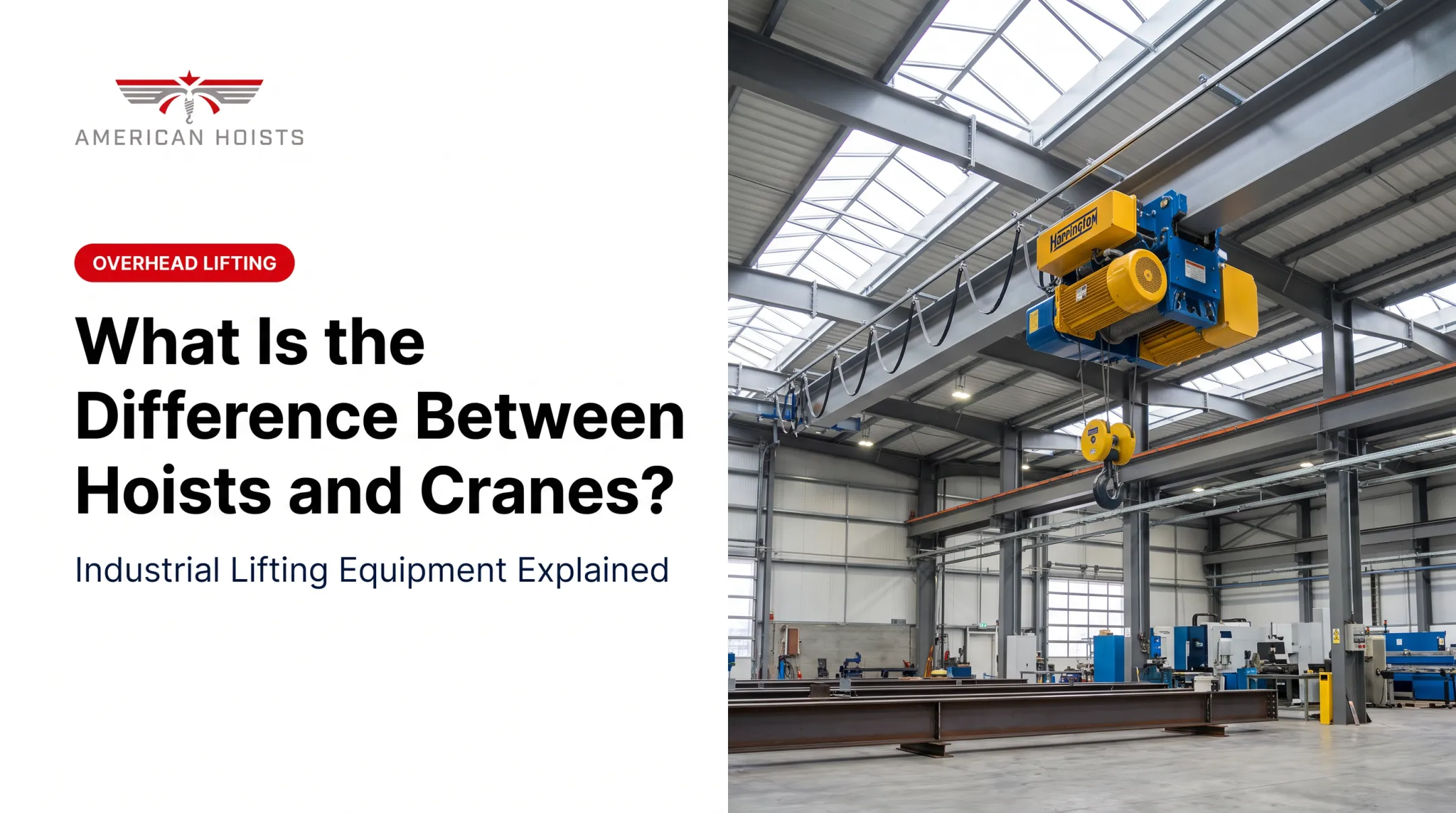
A crane is a complete lifting system: hoist, trolley, bridge, and runway working together to cover a facility floor in multiple directions. OSHA defines an overhead crane as a movable bridge carrying a hoisting mechanism on a fixed runway.
That horizontal reach is the whole point. A crane doesn't just lift heavier loads. It repositions them across a workspace, which cuts bottlenecks and speeds up material flow.
Crane Configurations
- Overhead bridge cranes — Broad bay coverage; the trolley travels along bridge rails
- Gantry cranes — Bridge supported by floor-traveling legs; useful when you can't attach to building structure
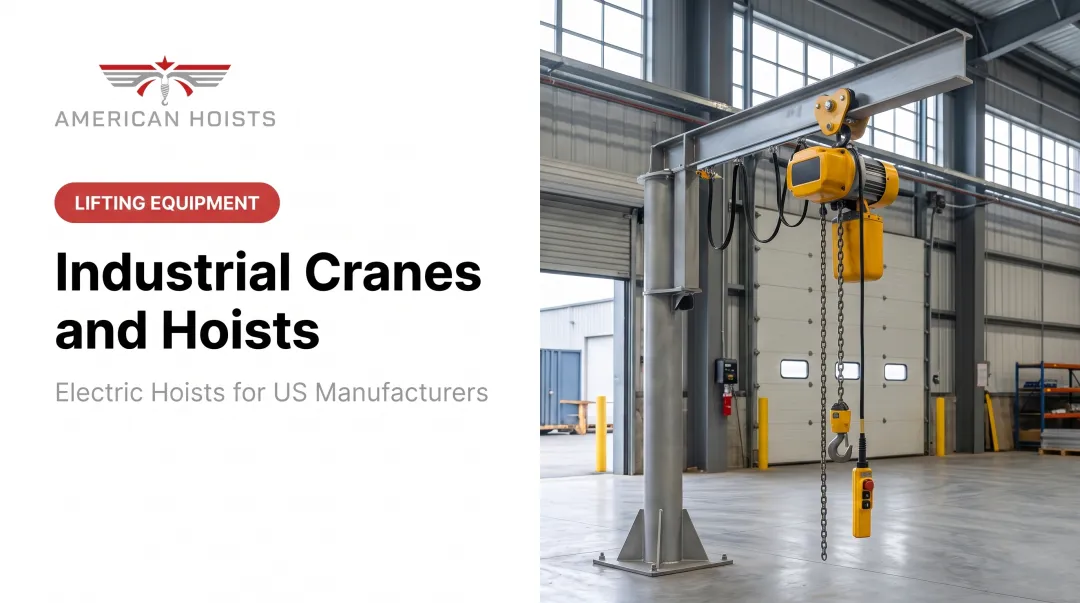
- Jib cranes — Rotate around a mast or column, typically 180-360 degrees; ideal for a single workstation
- Monorail systems — Follow one fixed path, straight or curved; good for repeatable process routes

American Hoists supplies equipment for several of these setups: crane kits in underhung and top-running configurations (1–20 tons), plus jib cranes from 1/4 to 5 tons, wall-mounted or freestanding.
Where Cranes Fit in Heavy Manufacturing
Steel fabrication, heavy equipment manufacturing, and large warehouse operations depend on cranes to move raw materials, position dies, and handle molds across the production floor.
Wells Concrete's Colorado facility installed four twin-girder, 25-ton EMH overhead cranes for a building expansion. According to CMAA's manufacturing case studies, operators could lift, reposition, and rotate concrete products without handling each piece multiple times, cutting material-handling steps on the floor.
Hoist vs Crane: Which Should You Choose?
Weigh these factors before you buy:
- Load weight — Under 20 tons and staying vertical? A hoist likely covers it. Heavier or needs floor coverage? Look at cranes.
- Facility headroom and span — Hoists need minimal clearance; cranes need runway height and bridge span room.
- Lifting frequency — High-duty, repetitive lifting favors wire rope hoists or crane systems built for continuous use.
- Budget — Hoists start in the low thousands; crane kits typically run about $19,000–$25,500 depending on capacity and configuration.
- Does the load need to travel across the floor? This is the deciding question. If yes, you need a crane. If no, a hoist alone often suffices.
Rule of thumb: Choose a hoist for fixed-point, lower-volume lifting in tight spaces. Choose a crane system when loads must move across a production floor repeatedly.
American Hoists supplies both sides of this decision — heavy-duty crane kits, jib cranes, and wire rope or chain hoists built for continuous 24/7 operation. You can source either solution, or a combined hoist-and-crane setup, from one U.S. supplier with round-the-clock specialist support.
Real-World Example: Matching Equipment to Operational Needs
A T&M Cranes case study on Olympic Steel illustrates what happens when equipment doesn't match operational demands. Frequent crane breakdowns halted production, and the customer had already spent more than $2 million on parts and labor trying to keep unreliable equipment running.
The fix: replacing failing machinery with properly specified in-house builds, combined with modernization and proactive maintenance. The reported results included:
- Eliminating the $2M annual maintenance drain
- Achieving zero downtime
- Passing 100% of monthly safety inspections
Matching equipment to the actual movement requirement — not just the load weight — prevents costly rework and downtime.
If you're not sure whether your facility needs a standalone hoist, a crane kit, or a jib crane, request a custom quote from American Hoists. Specialists will help you spec the right configuration based on your load, span, and duty cycle — and you'll get $250 off your first hoist order.
Conclusion
The right choice depends on your specific movement, load, and space requirements. Hoists handle vertical, fixed-point lifting. Cranes handle full-range material movement across a floor.
Get that match right, and you reduce downtime, improve safety, and keep production running with consistent 24/7 reliability.
Frequently Asked Questions
What is the difference between a hoist and a crane?
A hoist lifts and lowers loads vertically. A crane moves loads both vertically and horizontally, and often incorporates a hoist as one component of the larger system.
What is a hoist in a crane?
The hoist is the lifting mechanism mounted on a crane's trolley. It's responsible for raising and lowering the load, while the crane's bridge and trolley handle horizontal movement.
What is the difference between a hoist and a lift?
"Lift" is a general term for raising loads or people by any means. A hoist specifically refers to the mechanical device (chain or wire rope) used for vertical lifting.
What is the difference between lifting and hoisting?
Lifting is the broad action of raising a load, regardless of method. Hoisting specifically means using a mechanical hoist device to do it.
What are the different types of hoists?
The main types are manual chain, electric chain, and wire rope hoists. Electric chain hoists typically cover 1/8 to 20 tons; wire rope hoists handle higher capacities, often starting around 3 tons.
What are the three types of cranes?
Overhead bridge cranes offer broad bay coverage. Gantry cranes use floor-traveling legs instead of building-mounted runways. Jib cranes rotate around a fixed column for workstation-level lifting.